
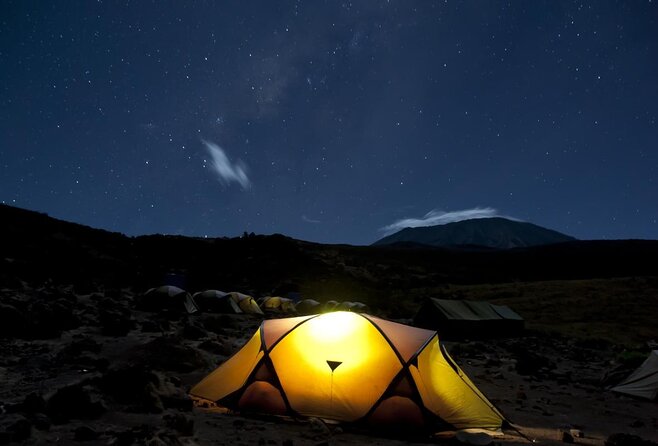
Reviewed · KILIMANJARO TREKS
5 Days Kilimanjaro Trekking – Marangu Route
Kilimanjaro’s Marangu Route gives you Africa’s highest summit in just five days, with the unusual comfort of sleeping in huts rather than tents. You move from rainforest to open moorland and high volcanic slopes, then make the midnight push toward Uhuru Peak at 5,895 meters.
I like the private-tour format, since your guide can adjust the pace and check on your condition closely. I also like the acclimatization day at Horombo, an easy-to-skip part of the schedule that may make the difference between reaching the summit and turning back.
The tradeoff is the short timetable. Five days is a demanding ascent, and the Marangu Route’s gentle nickname, the Coca Cola route, should not fool you. The summit day is long, cold, steep, and affected by thin air.
Key points to know before booking
- Five days to Uhuru Peak: You climb from Marangu Gate through Mandara and Horombo before the summit attempt.
- Hut accommodation: Four nights are spent in mountain huts rather than tents.
- One key acclimatization day: The optional trek toward Zebra Rocks or Mawenzi Tarn helps your body adjust to altitude.
- Private support: A professional guide leads only your group, with pickup and drop-off included.
- Dramatic scenery: Expect rainforest, giant senecio, lobelias, moorland, scree, snow, and views of Mawenzi and Kibo.
- A demanding summit schedule: The climb begins around midnight to 2 a.m. and may take four to five hours just to reach Gilman’s Point.
What the five-day Marangu trek is really like
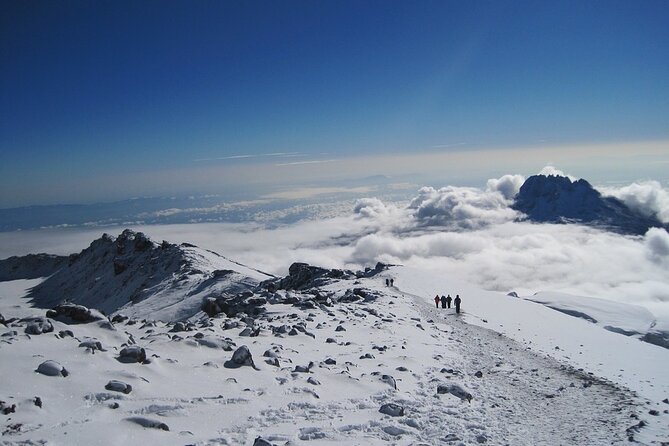
The Marangu Route is often called the Coca Cola route because it is considered the easier and more direct option on Kilimanjaro. That label is useful only up to a point. The path is generally well established, and hut sleeping is simpler than camping, but the mountain does not become easy at altitude.
You climb Kilimanjaro, Africa’s highest mountain and the world’s tallest free-standing mountain, to Uhuru Peak at 5,895 meters. The mountain has three major volcanic centers: Shira, Mawenzi, and Kibo, with Kibo holding the summit and its famous crater rim.
I like the way this route changes scenery quickly. The lower trail passes through thick forest, the middle slopes open into moorland, and the upper section becomes a severe world of rock, snow, and thin air. You get a strong sense of the mountain’s changing climate without needing technical climbing equipment.
This is a private activity, so only your group takes part. That matters on a physical trip. A guide can keep the pace steady, respond to how you are feeling, and make adjustments without having to match a large mixed group. Past groups have been guided by Alex and Godfrey, among others, and the guide team includes porters and a cook.
Other routes up the mountain from Moshi:
- Kilimanjaro climb by Lemosho Route (7-day)
★ 5.0 · 651 reviews - Kilimanjaro climb, Machame Route (7-day)
★ 5.0 · 262 reviews - Kilimanjaro Climbing Lemosho Route 8 Days.
★ 5.0 · 186 reviews
Starting at Marangu Gate from Moshi or the airport
Your day begins with pickup from the airport or your accommodation. The vehicle takes you to the Marangu starting gate, where the trek begins. The itinerary allows for an early airport pickup, but you should pay close attention to your arrival time and energy level before choosing a same-day start.
The price is $1,460 per person. That includes four nights of accommodation, park fees and other taxes, a professional guide, lunch, hotel pickup and drop-off, and the private-tour arrangement. Alcoholic drinks and souvenir photographs cost extra.
For a Kilimanjaro trip, the value is not just the transport. Park fees, guide support, porters, hut nights, and the logistics of moving a small group up and down the mountain all form part of the cost. Still, check exactly which meals are covered before you book. Lunch is specifically included, while the available details do not clearly list every breakfast or dinner.
The operator also offers vegetarian food if you request it at booking. Give them any other dietary requirements at that stage rather than waiting until you arrive.
Day one: rainforest and Mandara Hut
The first walking day takes you through the lower slopes toward Mandara Hut. The exact walking times are not fully set out in the schedule, but this first section is the forest approach to the mountain.
The rainforest is more than a warm-up. It gives you shade, damp air, dense vegetation, and a clear contrast with the bare slopes above. This is where you may see the first signs that Kilimanjaro is not one uniform climb. You begin in a living, enclosed environment and gradually leave it behind.
The route then moves toward higher ground and the Mandara area. The hut system is a major practical advantage for this itinerary. You do not need to pitch a tent at the end of the day, though a hut does not remove the need for warm clothing, a sleeping bag, or careful packing.
Your first night is a good time to watch how your body responds. Headache, tiredness, poor sleep, and shortness of breath can begin as you gain height. Tell the guide early if something feels wrong. On a five-day schedule, it is tempting to hide discomfort and press on, but that is a poor strategy on a high mountain.
Day two: Mandara to Horombo at 3,700 meters
The walk from Mandara Hut to Horombo Hut takes about three to four hours. After roughly 15 minutes, the route leaves the rainforest and enters open moorland.
This change is one of the best parts of the trek. The trail opens up, and you can look across to Mawenzi and toward Kibo, the snow-capped volcanic summit. Giant senecio and lobelias add an odd, almost prehistoric touch to the high vegetation.
Horombo Hut sits at about 3,700 meters. That is high enough for altitude symptoms to begin, and the itinerary warns you directly about it. Walk slowly, drink as advised by your guide, and do not treat this day as a race. The purpose is to reach camp in reasonable shape, not to arrive first.
I like this stage because it gives you the first broad mountain views without yet requiring the extreme summit effort. The drawback is that the altitude can feel more serious than the walking distance suggests. A three-hour path at 3,700 meters may leave you more tired than a longer walk at home.
Same base, a different kind of day out:
- Safari Serengeti And Ngorongoro
★ 5.0 · 288 reviews - Climbing Kilimanjaro – Machame Route
★ 5.0 · 170 reviews - Climbing Kilimanjaro through 7 days Machame Route
★ 5.0 · 151 reviews - Kilimanjaro climb, Lemosho Route (8-day)
★ 5.0 · 148 reviews
Day three: the Horombo acclimatization day
The third day starts and ends at Horombo Hut. You can rest at camp, but the stronger choice for many fit hikers is the optional day trek toward Zebra Rocks at 4,200 meters and Mawenzi Tarn Hut at 4,300 meters.
This is an important part of the plan. You climb higher during the day, then return to sleep lower at Horombo. That pattern gives your body more time to adjust before summit night. On a five-day trek, you do not have much spare time for acclimatization, so skipping this day may reduce your chances of reaching Uhuru Peak.
The walk also adds variety. Mawenzi is a separate volcanic cone with a rough, sharply cut profile, while the rocks and high vegetation around Horombo show how quickly the mountain changes above the forest.
You may choose to rest instead, especially if you have a headache or feel unwell. Your guide should help you make that call. Resting is not failure, but you should understand the tradeoff: the extra walking day is tiring, yet it is also the schedule’s main altitude buffer.
Day four: the midnight climb to Gilman’s Point
Summit day begins very early, normally between midnight and 2 a.m. You climb steep ground covered with heavy scree or snow toward Gilman’s Point on the crater rim.
The first section to Gilman’s Point takes about four to five hours. At 5,861 meters, this is already a major achievement. The trail is steep, the air is thin, and the darkness can make the climb feel slow. Your guide sets the pace, and you should expect a deliberate, measured walk rather than a normal hiking rhythm.
From Gilman’s Point, you continue for another one to two hours toward Uhuru Peak. The summit sits at 5,895 meters, the highest point in Africa. The route is short in distance compared with the earlier days, but altitude makes every step count.
The schedule promises wide views and time for a summit photograph. Keep expectations sensible. Cloud, snow, wind, or fatigue can affect what you see, and the most important goal is reaching the top safely and returning with enough energy.
After Uhuru Peak, you descend to Kibo for lunch and a rest, then continue down to Horombo Hut. That return takes another three to four hours. This is a very long day, and the descent can be hard on tired knees even though you are losing altitude.
I consider this the biggest strength and weakness of the itinerary. You have a clear, direct summit plan, but you also face a huge amount of walking in one day. The guide team’s calm pacing and frequent checks are especially valuable here. Several past groups praised the patient pace, caring attention, food, and support from guides, porters, and the cook.
Day five: back through the forest to Moshi
After breakfast, you descend from Horombo through the moorland to Mandara Hut at about 2,700 meters. From there, the trail continues through lush forest toward Marangu Gate at roughly 1,830 meters.
The lower trail may be wet and muddy. Gaiters and trekking poles are useful, and you should keep rain gear within reach even if the morning begins dry. At the lowest elevations, shorts and a T-shirt may be comfortable, but do not pack away warmer layers too soon.
A vehicle waits at the gate. The plan includes a hot lunch before the drive back to Moshi or Arusha, or an airport drop-off if you are flying out that day. I would allow plenty of spare time before a flight. The schedule gives you a full descent day, and mountain timing can shift with weather, walking speed, or health concerns.
The final descent provides a satisfying change in mood. You leave the stark upper slopes, return to vegetation, and finish where the trek began, at the Marangu side of the park.
Huts, food, guides, and private support
The four included nights are in mountain huts. This is the route’s main comfort advantage over a camping itinerary. You still need to prepare for basic mountain conditions, but you avoid carrying a tent or sleeping in one.
The food earns special attention. Past groups have singled out the cook’s meals as excellent, with one group saying the food was better than what they usually ate at home. Another group praised the food, service, pace, guides, and porters together. Those comments do not replace checking the current menu or meal inclusions, but they suggest that food is treated as an important part of the operation.
The guide team is also a key part of the experience. Past groups worked with Alex and Godfrey, and the wider support team included guides, a chef, and porters. One private group reached Uhuru Peak together, helped by a pace that could be slowed or adjusted when needed.
Ask about the full support team before departure, including guide-to-client arrangements, porter welfare, and what you should carry yourself. Those details matter on a mountain trip, even though they are not fully stated in the booking information.
Who should choose this five-day route?
This trek suits you if you want a private Kilimanjaro climb with hut accommodation, a direct route, and a fixed five-day schedule. It is also a sensible match if you value airport or hotel pickup and want the operator to handle transport to and from the park.
You should have a moderate level of physical fitness. That does not mean you need to be an elite athlete, but you should be ready for several days of walking, a midnight start, steep scree, cold conditions, and a long descent after the summit.
I would be cautious about booking this exact duration if you have no high-altitude experience or if you are trying to fit the mountain into a tightly packed holiday. The optional Horombo acclimatization day helps, but five days remains a short schedule for a mountain reaching 5,895 meters.
The route is not suitable for children to tackle independently. Children must be accompanied by an adult, and the child rate applies only when sharing with two paying adults.
Practical booking details and cancellation
Confirmation is provided at booking. The tour operates Monday through Sunday, with listed hours covering the full day. It runs in all weather conditions, so you need clothing for rain, cold, mud, wind, and changing temperatures.
Free cancellation is available up to 24 hours before the start time for a full refund. Changes made inside that 24-hour period are not accepted, and late cancellations are not refunded. The activity also requires a minimum number of participants, although it is otherwise a private tour for your group.
Should you book the Marangu Route in five days?
Book it if you want a private, hut-based Kilimanjaro climb with straightforward logistics, supportive guide and porter service, and an itinerary that includes a useful acclimatization day. The rainforest, giant senecio, Mawenzi views, crater rim, and Uhuru summit give you a full range of mountain scenery.
Think carefully if your main goal is the highest possible summit success rate. The five-day schedule is efficient, but it leaves little room for slow acclimatization or delays. You should arrive fit, take the Horombo day seriously, and accept that the summit attempt will be long and physically demanding.
At $1,460 per person, the trip offers solid value if the listed transport, park fees, hut nights, guide, lunch, and private service match what you need. Before paying, confirm the full meal plan, pickup time, guide arrangements, and airport timing. If those details suit your plans, this is a practical way to experience Kilimanjaro without giving up the comfort of hut accommodation.
FAQ
How long is the Kilimanjaro Marangu Route experience?
The trek lasts approximately five days and includes four nights of accommodation on the mountain.
Where does the trek begin?
The trek begins at the Marangu starting gate. Pickup is available from the airport or your accommodation before the drive to the gate.
How high is Uhuru Peak?
Uhuru Peak is 5,895 meters above sea level, or 19,340 feet.
How early does the summit climb begin?
The summit attempt starts very early, usually between midnight and 2 a.m.
How long does it take to reach Gilman’s Point?
The climb from the start of summit day to Gilman’s Point takes about four to five hours.
Is there an acclimatization day?
Yes. The third day starts and ends at Horombo Hut. You can rest or take an optional trek to Zebra Rocks and Mawenzi Tarn Hut.
Where do you sleep during the trek?
The package includes four nights of accommodation in mountain huts.
Is vegetarian food available?
Yes. A vegetarian option is available, but you should request it when booking. You should also provide any other dietary requirements at that time.
What happens after the descent?
A vehicle meets you at the Marangu gate. You receive a hot lunch, then travel back to Moshi or Arusha, or to the airport if you are flying out that day.
More Hiking & Trekking in Moshi
- Private Kilimanjaro Hike 7 Day Lemosho Route
★ 5.0 · 60 reviews - Best Kilimanjaro hiking day trip tour with Kilinge Adventures
★ 4.5 · 54 reviews - #1. Best Kilimanjaro Day hike Tour-Machame Route-ISMANI
★ 4.2 · 47 reviews - Best Kilimanjaro Adventure 7 days Machame route Trekking
★ 5.0 · 42 reviews
Just added in Moshi
- Wildlife Extravaganza: Manyara, Tarangire & Ngorongoro in 3 Days★ 5.0 · 3 reviews
- West Kilimanjaro cycling Adventures★ 4.5 · 8 reviews
- machame route★ 5.0 · 16 reviews
- Kilimanjaro Climb • Machame Route ~ 10 Day★ 5.0 · 6 reviews
- Kilimanjaro Climbing Umbwe Route★ 5.0 · 3 reviews
- Mt Kilimanjaro 6 days Marangu route hike★ 5.0 · 3 reviews
- 3 Days Private E-Bike Tour in West Kilimanjaro★ 5.0 · 3 reviews
- Private Cycle to Kilimanjaro Bike Park Safari★ 5.0 · 6 reviews
Kilimanjaro Treks, compared.



8-Day Small-group Lemosho Kilimanjaro Summit Trekking
Read our review →

5 Days Best of Tanzania Luxury Safari Northern Circuit
Read our review →

Climbing Kilimanjaro through 7 days Machame Route
Read our review →
7-Day Machame Kilimanjaro Summit Tour from Arusha
Read our review →Browse the lists this tour appears in