
Reviewed · KILIMANJARO TREKS
6-Day Kilimanjaro Umbwe Route–Steep,Adventurous, Challenging Path
The Umbwe Route takes the most direct and demanding line up Mount Kilimanjaro. In only six days, you climb from humid rainforest to Uhuru Peak at 5,895 meters, sleep beside glaciers in the crater, and descend through the Mweka forest. This is not a gentle introduction to high-altitude trekking.
I like the route for two clear reasons: it is quieter and more adventurous than the popular approaches, and the scenery changes quickly from dripping forest to giant lobelias, bare volcanic rock, ice fields, and the summit snow. The crater camp on Day 4 is the route’s rare prize.
The trade-off is serious. The steep ascent and fast altitude gain leave little room for an easy adjustment, especially around Lava Tower, Arrow Glacier, and the Western Breach. Choose this climb only if you have strong fitness, solid preparation, and a clear understanding that emergency oxygen is for emergencies, not a shortcut to the summit.
Key points before you book
- The Umbwe Route is steep from the start: You enter the rainforest on Day 1 and climb hard toward Bivouac Camp.
- Crater camping is included: Spend a night at about 5,700 meters near the Northern Ice fields and Furtwangler Glacier.
- The summit day begins at 4:00 a.m.: Expect about two hours from the crater to Uhuru Peak, followed by a long descent to Mweka.
- The route includes high-altitude trouble spots: Lava Tower reaches 4,630 meters, while Arrow Glacier Camp is about 4,800 meters.
- Your support team carries the camp operation: A mountain guide, assistant guides, porters, and cook are included, along with tents, mattresses, meals, and water.
- This is a private activity: Only your group takes part, and pickup from Moshi plus airport transfers are included.
What the $2,310 price covers
At $2,310 per person, this is a substantial purchase, but much of the costly mountain work is already covered. You receive return transfers between Kilimanjaro Airport and Moshi, park fees and other taxes, a qualified guide team, porters, a cook, tents, camp furniture, sleeping mattresses, meals, drinking water, and hot water for washing each day.
That matters on a climb where the support system is almost as important as your own legs. The porters organize and carry the camp, the cook prepares breakfast, lunch, and dinner, and the guides handle park registration and route leadership. You are not buying a simple guided walk. You are paying for a mobile camp on a high mountain.
The price does not include flights, visas, travel insurance, health insurance, personal trekking gear, medicine, water-purifying tablets, snacks, or meals and drinks not specified. An optional portable toilet is highly recommended and costs extra. You can rent personal equipment from shops in Moshi, but you should settle that before heading up the mountain.
The package lists five breakfasts, six lunches, and five dinners. That covers the full six-day schedule, including the packed lunch on the first day and food for the long summit and descent day. Bring personal snacks if you use them for energy, since snacks are not included.
Other routes up the mountain from Moshi:
- Kilimanjaro climb by Lemosho Route (7-day)
★ 5.0 · 651 reviews - Kilimanjaro climb, Machame Route (7-day)
★ 5.0 · 262 reviews - Kilimanjaro Climbing Lemosho Route 8 Days.
★ 5.0 · 186 reviews
Day 1: Umbwe Gate to Bivouac Camp
Your climb begins with an early breakfast at your Moshi hotel, followed by pickup and a drive to Umbwe Gate. Before setting out, you can buy mineral water, collect a packed lunch, and watch the porters organize the equipment. You and your guide register with Tanzania National Parks, then the forest closes around the trail.
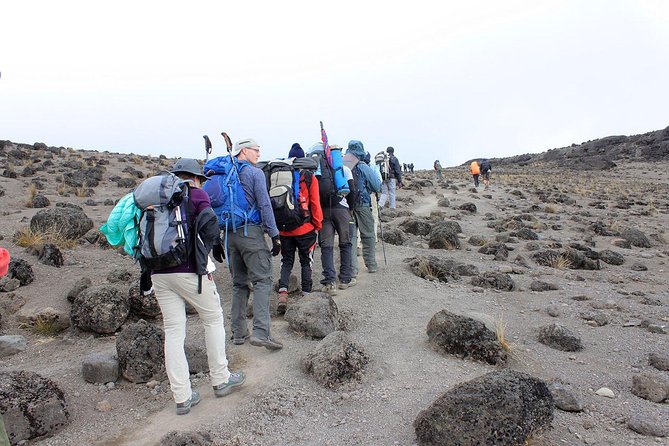
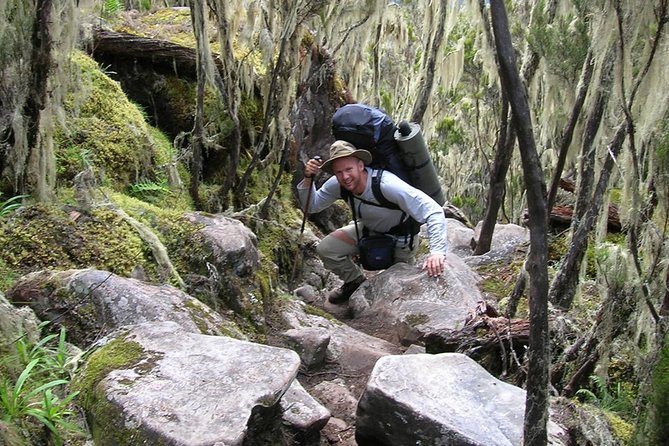
The first section is roughly five hours to Bivouac Camp at 2,940 meters. The Umbwe forest is wet, muddy, and often foggy. Expect a steep start rather than a warm-up stroll. Rain gear and shoes with reliable grip matter here.
This is also the part where you may spot wildlife, including colobus monkeys. The forest gives you a proper Kilimanjaro entrance, with thick vegetation and changing weather instead of an instant view of bare rock.
Lunch comes about halfway up the trail. By late afternoon or early evening, you reach camp, where the tents should already be set up. The porters and cook handle drinking water, washing water, and dinner while you recover.
The first night reveals the main issue with this route: the climb begins at once. If your legs feel overworked on Day 1, you should take that seriously. There is no long, flat approach to help you settle in.
Day 2: Moorland, giant plants, and Barranco Wall
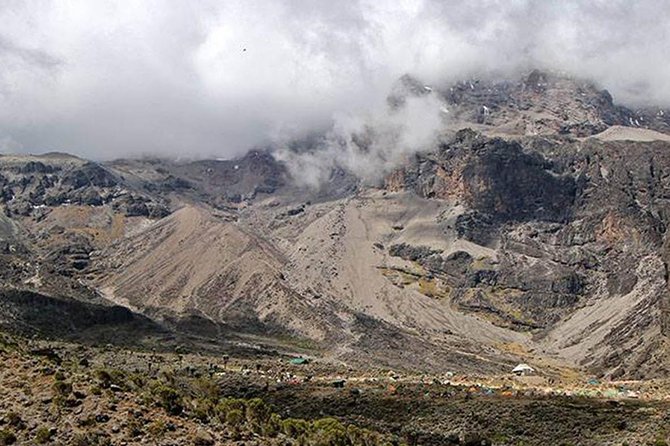
Day 2 takes about six hours. You leave the rainforest behind and enter heathland and moorland, where the vegetation becomes shorter and stranger. Giant lobelias and groundsel give the route a distinctly high-mountain character.
As you climb, views of Kilimanjaro open up. The trail eventually flattens before descending into the Barranco Valley and Barranco Camp. This change is useful because the route is not simply an unbroken uphill push, but the earlier gain still makes the day demanding.
Barranco Camp sits beside a stream, with the Western Breach and Great Barranco Wall in view. The setting is one of the strongest parts of this section. You get a clear sense of the volcanic terrain ahead, and the wall gives the next days a serious edge.
Your tent should be ready when you arrive. The crew prepares food and water while you rest. The support arrangement received strong praise for organization, friendly service, food, and care. Names connected with the company include guide Godfrey, while other accounts describe guides and porters who kept people safe, fed, and comfortable. Since guide assignments can vary, you should confirm your own team before departure.
Day 3: Lava Tower and Arrow Glacier Camp
Day 3 is about seven hours and moves through moorland into semi-desert. The scenery becomes rocky and spare as you head east toward Lava Tower at 4,630 meters. This is where altitude often begins to announce itself with headaches and shortness of breath.
You eat a packed lunch at Lava Tower. If weather allows, you may climb the tower itself, though the main route continues upward. The optional scramble adds interest, but it also adds effort at a point when you may already feel the altitude.
After lunch, you climb a steep Class 2 trail toward Arrow Glacier Camp at about 4,800 meters. Vegetation is scarce, and the trail becomes more of a rock scramble than a normal mountain path. This is not a day for rushing. Short steps, steady breathing, and close attention to your guide’s pace are more useful than trying to prove your strength.
The high camp gives you a direct taste of the route’s difficulty. You are now well above the height where many people sleep comfortably, and the schedule is pushing you toward an even higher crater camp the next day. Strong fitness helps, but fitness alone does not guarantee an easy response to altitude.
Emergency oxygen and a basic first aid kit are included. The oxygen is explicitly for emergencies only and is not provided as summit aid. You should also bring your own personal medicine and water-purifying tablets, since those are not part of the package.
Same base, a different kind of day out:
- Safari Serengeti And Ngorongoro
★ 5.0 · 288 reviews - Climbing Kilimanjaro – Machame Route
★ 5.0 · 170 reviews - Climbing Kilimanjaro through 7 days Machame Route
★ 5.0 · 151 reviews - Kilimanjaro climb, Lemosho Route (8-day)
★ 5.0 · 148 reviews
Day 4: The Western Breach and crater camp
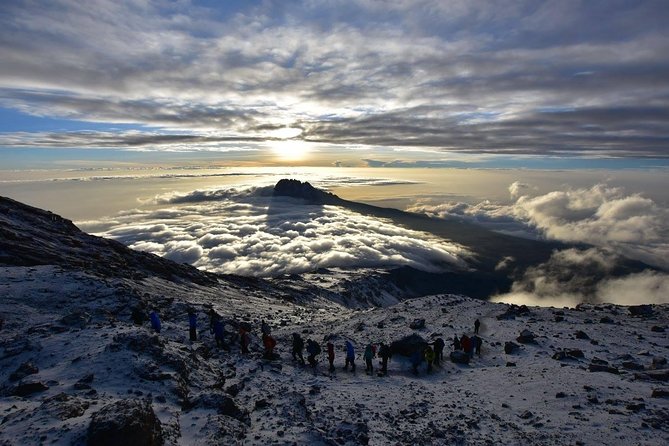
Day 4 takes about five hours and is the route’s most unusual camping day. After breakfast, you continue scrambling over rock on a Class 2 trail and slowly climb the Western Breach toward the crater at about 5,700 meters.
During the rainy season, an ice axe and crampons are required because of icy conditions. The supplied information does not state that these are included, so you need to ask the operator about equipment arrangements before departure. This is one of the most important practical questions to settle.
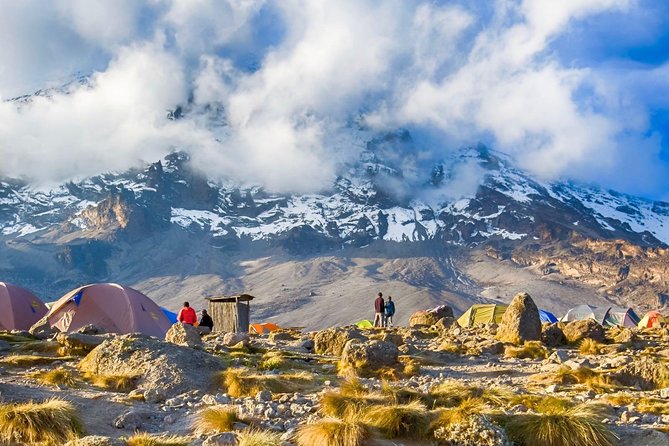
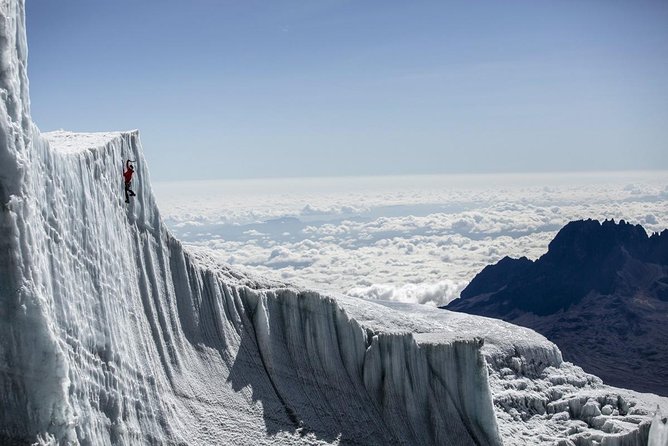
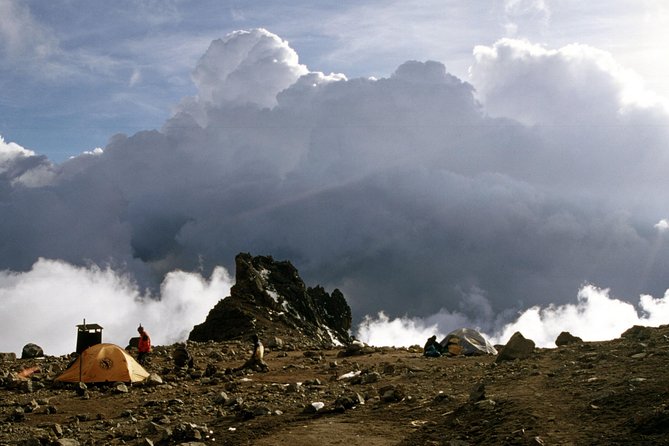
At the crater rim, you see the Northern Ice fields and Furtwangler Glacier. The campsite is on stone scree beside the snow-covered inner crater. There is also an optional hike to the Ash Pit, a crater measuring about 340 meters across and 120 meters deep. The walk takes about an hour and a half.
Crater Camp is a remarkable reward, but it is not a comfortable low-altitude rest stop. At roughly 5,700 meters, you may find sleep difficult, and the cold and thin air can make even simple tasks feel slow. The route’s appeal comes partly from this rarity: very few people get to spend a night inside Kilimanjaro’s crater.
You receive a warm dinner at camp. Keep your expectations practical. This is mountain camping at extreme altitude, not a lodge stay with room to spread out. The spectacular setting comes with real physical cost.
Day 5: Uhuru Peak, then the long drop to Mweka
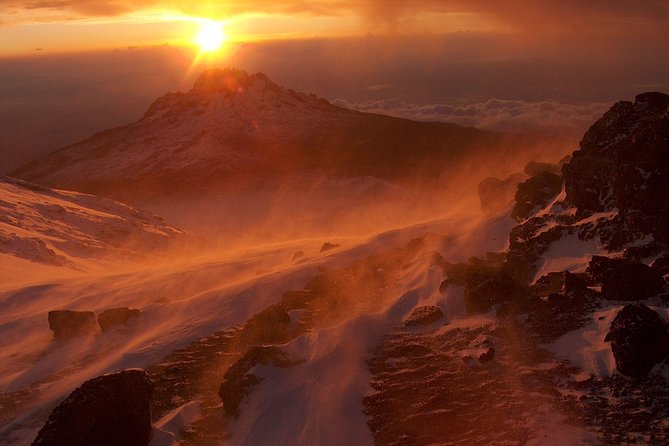
Summit morning begins around 4:00 a.m. with tea and biscuits. From the crater, it is about two hours to Uhuru Peak, the highest point on Kilimanjaro at 5,895 meters.
The trail is snow-covered, and this short distance can feel like the hardest part of the entire climb. You may be tired from the previous days, cold from the early start, and affected by the altitude. The goal is not speed. Follow the guide, keep your pace controlled, and save enough energy for the descent.
At the summit, you have a short time for photographs and tea before heading down. The schedule then becomes exceptionally long: about seven to eight hours to Mweka, with roughly seven kilometers of ascent and 23 kilometers of descent listed for the day.
That descent is the part many people underestimate. Reaching Uhuru Peak is the headline achievement, but your knees and feet still have a great deal of work ahead. Make sure your footwear is broken in, your socks are suitable for long days, and your pack is arranged so you can reach water and snacks without fuss.
You descend first through the crater and summit zone, then continue toward Mweka at about 3,100 meters. The sharp loss of altitude may feel welcome, but the total time on your feet makes Day 5 the hardest day by a wide margin.
Day 6: Mweka Gate and the return to Moshi
After breakfast, the mountain crew holds a celebration with dancing and singing. This is also the point when you present tips to the guide, assistant guides, cook, and porters. Tipping is not included in the listed price, so plan for it as a separate expense.
The walk to Mweka Gate takes about three hours and covers approximately 15 kilometers through forest. At the national park gate, you sign your name and receive a completion certificate. Reaching Stella Point at 5,685 meters earns a green certificate, while reaching Uhuru Peak earns a gold certificate.
After the gate, you descend for about an hour to Mweka village, a further three kilometers. The activity then ends back at the meeting point in Moshi. The return transfers to Kilimanjaro Airport are included, which is useful if the climb is part of a larger Tanzania trip.
What the support team adds
The organization receives especially strong praise for customer service and attention to detail. Airport pickup, hotel arrangements, local help, food, camp setup, and transport can make a major difference before and after a hard climb.
Your mountain team includes a lead guide, assistant guides, porters, and a cook. Tents, chairs, tables, mattresses, drinking water, and daily hot washing water are supplied. Those details may sound basic, but they reduce the number of problems you must solve after a six or ten-hour hiking day.
The private format also has an advantage. Only your group participates, so the pace and daily decisions are not tied to a large public group. The available information does not give a maximum group size, so ask how many people will be in your party and how many staff members will accompany you.
Group discounts are offered. Ask for the exact discount before paying, since no percentage is provided.
Who should choose this route?
I would recommend the Umbwe Route to an experienced trekker who wants a steep, direct climb and accepts the risks of fast altitude gain. It suits someone who values dramatic scenery, low-crowd appeal, crater camping, and a demanding schedule more than comfort or a gradual introduction.
It is a poor fit if you are new to multi-day trekking, unsure about your fitness, or mainly interested in an easy path to the summit. The activity specifically requires a strong physical fitness level, and that warning should guide your decision.
You should also be comfortable with wet forest trails, mud, fog, rocky scrambles, possible ice, early starts, and a very long summit day. The reward is a remarkable route through several of Kilimanjaro’s ecological zones, but the route does not hide its difficulty.
Booking confirmation is provided at the time of booking. You can cancel at least three full days before the start time for a full refund. Cancellations or changes made within three full days are not accepted for a refund, and the cutoff follows local Tanzanian time.
Should you book the 6-Day Umbwe Route?
Book it if you want the toughest and most direct option in this package, have strong fitness, and are prepared for an intense altitude schedule. The crater night, Western Breach, Lava Tower, and summit approach give the six days a powerful sense of progression.
Do not book it simply because the trip is shorter. Six days saves time, but it also gives your body less opportunity to adjust. For the right person, this is an adventurous and well-supported climb with unusual scenery and a real sense of achievement. For a first mountain trek, a slower route may be the wiser choice.
FAQ
Where does the Kilimanjaro Umbwe Route tour start?
The activity starts in Moshi Urban, Tanzania, with pickup offered from Moshi.
How long does the experience last?
The climb lasts approximately six days.
Is this a private tour?
Yes. Only your group participates in the activity.
Are airport transfers included?
Yes. Return transfers between Kilimanjaro Airport and Moshi are included.
Is camping equipment provided?
Yes. Tents, camp chairs, tables, and sleeping mattresses are included.
Are meals included?
Yes. The package includes five breakfasts, six lunches, and five dinners.
Is personal trekking gear included?
No. Personal hiking and trekking gear is not included, though you may rent equipment from stores in Moshi.
Is emergency oxygen provided?
Yes. Emergency oxygen and a basic first aid kit are included. The oxygen is for emergencies only and is not intended as summit aid.
Just added in Moshi
- Wildlife Extravaganza: Manyara, Tarangire & Ngorongoro in 3 Days★ 5.0 · 3 reviews
- West Kilimanjaro cycling Adventures★ 4.5 · 8 reviews
- machame route★ 5.0 · 16 reviews
- Mt Kilimanjaro 6 days Marangu route hike★ 5.0 · 3 reviews
- Kilimanjaro Climb • Machame Route ~ 10 Day★ 5.0 · 6 reviews
- Kilimanjaro Climbing Umbwe Route★ 5.0 · 3 reviews
- 3 Days Private E-Bike Tour in West Kilimanjaro★ 5.0 · 3 reviews
- Private Cycle to Kilimanjaro Bike Park Safari★ 5.0 · 6 reviews
Kilimanjaro Treks, compared.



8-Day Small-group Lemosho Kilimanjaro Summit Trekking
Read our review →

5 Days Best of Tanzania Luxury Safari Northern Circuit
Read our review →

Climbing Kilimanjaro through 7 days Machame Route
Read our review →
7-Day Machame Kilimanjaro Summit Tour from Arusha
Read our review →Browse the lists this tour appears in