
Reviewed · KILIMANJARO TREKS
Kilimanjaro-marangu Route 6 Days Itinerary
Kilimanjaro’s Marangu Route gives you the mountain’s most direct hut-to-hut climb, beginning in tropical forest and ending among volcanic rock and snowless high-altitude slopes. The route reaches Uhuru Peak at 5,895 meters, the highest point in Africa, but the summit day is a serious 13 to 15-hour effort.
I like the included airport transfers and the first night at Kilimanjaro Mountain Resort, which takes pressure off your arrival. I also like the extra acclimatization night at Horombo, plus the private format, where only your own group takes part. The main concern is the price, $1,950 per person, and the slightly confusing presentation: this is an eight-day trip overall, with six mountain days, not six total days.
Key points to know before booking
- Marangu uses huts instead of tents, with overnight stops at Mandara, Horombo, and Kibo.
- The summit day is extremely long, beginning before midnight and lasting about 13 to 15 hours.
- An extra Horombo night helps with acclimatization, but you still need good fitness and careful pacing.
- Airport transfers are included, from Kilimanjaro International Airport to Marangu and back.
- January, February, August, and September are the strongest months, while March through May brings long rains.
- This is a private climb, so your group does not share the activity with other booking parties.
What the $1,950 price really covers
At $1,950 per person, this is not a cheap mountain holiday. The value depends on how much practical support you want bundled into one booking.
The package includes airport pickup, the transfer to Kilimanjaro Mountain Resort, accommodation before and after the climb, mountain transport, park entry, huts, meals during the route, guides, and the return airport transfer. You are also given a pre-climb equipment check and a briefing about medical and travel insurance requirements.
That removes several moving parts. You do not need to arrange a separate taxi from Kilimanjaro International Airport, find a hotel in Marangu, or work out how to get back to the airport after descending. For a first Kilimanjaro climb, that simplicity has real value.
Still, you should ask for a precise list of inclusions before paying. The supplied details do not spell out every item of personal gear, porter arrangements, or drinks. They do confirm meals and accommodation, but not every expense you might face during preparation. At this price, clarity matters.
The operator, Africa Joy Tours, describes the climb as a private activity. That means your group has its own booking rather than being mixed with a larger public group. Private does not mean easy, though. The mountain schedule, hut locations, altitude, and summit pace remain the same.
Other routes up the mountain from Moshi:
- Kilimanjaro climb by Lemosho Route (7-day)
★ 5.0 · 651 reviews - Kilimanjaro climb, Machame Route (7-day)
★ 5.0 · 262 reviews - Kilimanjaro Climbing Lemosho Route 8 Days.
★ 5.0 · 186 reviews
Why the Marangu Route feels different
Marangu is often called the hut route because you sleep in built shelters rather than tents. That is its main practical advantage. You can leave the tent setup behind and spend the nights inside mountain huts at Mandara, Horombo, and Kibo.
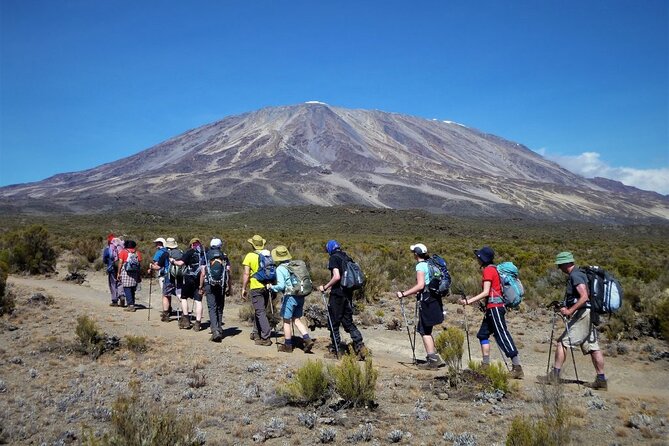
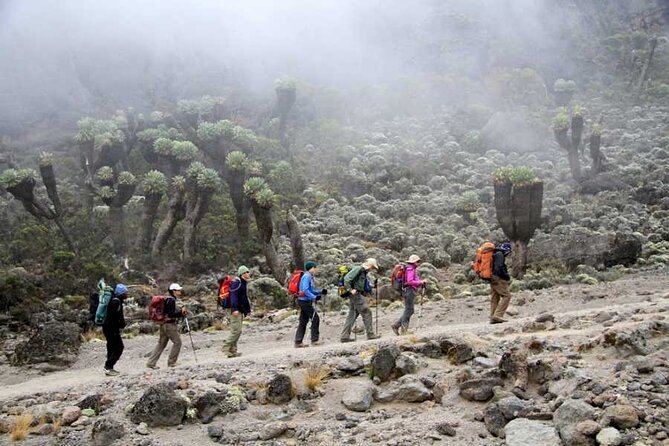
The route begins in rainforest, then moves through moorland, high desert, and volcanic scree. The changing scenery gives the climb a clear sense of progress. At first, the trees soften the walk. Later, the open slopes leave you exposed to wind, cold, and altitude.
The route is not simply a gentle walk to the top. The summit approach is steep and tiring, especially after sleeping at 4,700 meters. The extra night at Horombo helps, but no schedule can guarantee that your body will adapt well.
Your guides will repeatedly tell you to walk slowly and drink enough water. Take that advice seriously. On Kilimanjaro, a patient pace is not a sign of weakness. It is one of the simplest tools you have for reaching the summit.
Day 1: a quiet start at Kilimanjaro Mountain Resort
You can arrive at Kilimanjaro International Airport at any time on the first day. A private transfer is arranged to take you to Kilimanjaro Mountain Resort in Marangu.
The resort is on the lower slopes of Kilimanjaro and serves as your base before the mountain section begins. You have dinner and breakfast there, with time to rest after your flight and get used to the setting.
At 5:30 p.m., the group gathers for a pre-climb briefing and equipment check. This is an important meeting, not a formality. Use it to confirm what you are carrying, what the operator provides, and what still needs attention.
The team also checks that you have appropriate medical coverage and travel insurance. Bring your policy details and make sure you understand what happens if you become ill or need to leave the mountain.
The supplied schedule lists this first day as eight hours, which appears to refer to the overall activity window rather than walking time. You do not begin climbing on this day.
Day 2: Marangu Gate to Mandara Hut
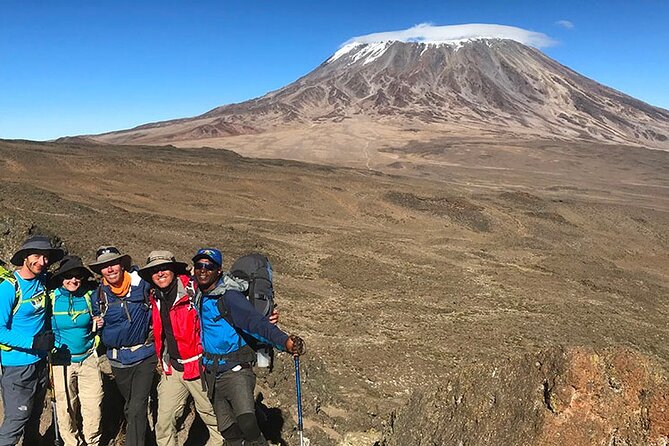
After breakfast, you take a short transfer from the hotel to the national park gate. Park formalities come first, then the walking begins.
The trail passes through tropical rainforest on the way to Mandara Hut at 2,700 meters. This is the most enclosed and shaded part of the route. The forest makes a pleasant opening to the climb, but the ground can feel demanding if you are still carrying too much water or equipment.
The walk takes about five to six hours. At Mandara, you have dinner and spend the night in the hut. You can also rest and enjoy the forest around camp.
This first mountain day is a good test of your packing choices. Keep essential layers and rain protection easy to reach. Even in the forest, weather can change, and you do not want to unpack your whole bag beside the trail.
Same base, a different kind of day out:
- Safari Serengeti And Ngorongoro
★ 5.0 · 288 reviews - Climbing Kilimanjaro – Machame Route
★ 5.0 · 170 reviews - Climbing Kilimanjaro through 7 days Machame Route
★ 5.0 · 151 reviews - Kilimanjaro climb, Lemosho Route (8-day)
★ 5.0 · 148 reviews
Day 3: Mandara to Horombo through moorland
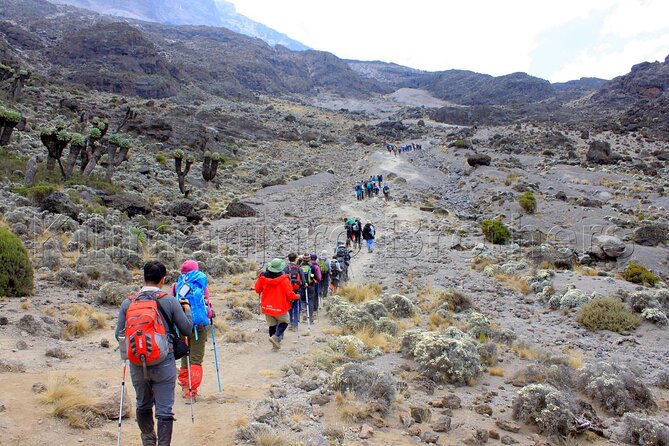
The trail begins with a steep section through forest, then opens into moorland. That change is one of the memorable parts of the climb. The trees thin out, the sky opens, and clear weather can reveal Kibo and Mawenzi.
You reach Horombo Hut at 3,720 meters after about four to six hours of walking. Arriving in mid-afternoon gives you some time to rest and look across the high slopes before dinner.
Horombo is more than a place to sleep. It is the main acclimatization point on this schedule. Your body is now dealing with a much higher elevation, and the extra night here is one of the strongest features of the route.
Expect the hut to feel basic. This is a mountain camp, not a hotel. The value comes from its position and from the chance to sleep at altitude, not from comfort or facilities.
Day 4: the Horombo acclimatization walk
The fourth day is deliberately shorter. You walk toward Mawenzi Hut and pass the Zebra Rocks, then return to Horombo for another night.
The listed walking time is about three hours. This shorter outing gives you a chance to move higher without immediately sleeping at the next elevation. It also lets you see more of the unusual volcanic terrain around Mawenzi.
The day may feel too easy compared with the other stages. That is the point. Do not treat it as wasted time or push for extra mileage. The schedule uses the day to improve your acclimatization before the move to Kibo.
Drink water throughout the day and keep your pace measured. All meals are provided at Horombo Hut, so you do not need to plan your own mountain food for this stage.
Day 5: Horombo to Kibo across the Saddle
The route now leaves Horombo and crosses the high, open Saddle between Mawenzi and Kibo. The surroundings become more barren, with the moorland giving way to a lunar-looking volcanic desert.
The walk to Kibo Hut at 4,700 meters takes roughly four to six hours in the stated schedule, though the description also refers to a six to seven-hour effort. Plan for a long, slow day rather than relying on the shorter estimate.
There is no running water at Kibo Hut. That detail matters. Follow the team’s instructions about your water supply, and make sure you have enough for the evening and the summit start. You spend the rest of the day resting and preparing for a very early night.
Kibo is where the climb becomes more serious. You are high, the air is thin, and there is little to distract you from the next morning’s effort. Eat what you can, organize your layers, and keep your summit equipment close.
Day 6: Gillman’s Point, Uhuru Peak, and Horombo
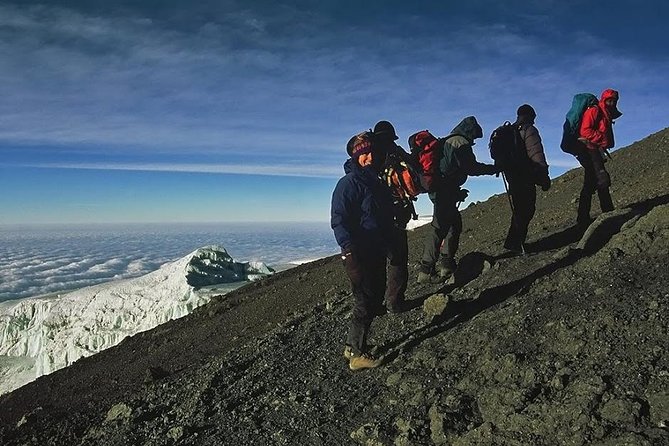
The summit day begins before midnight. You leave Kibo in darkness and climb over loose volcanic scree toward the crater rim.
The route includes well-graded zigzags, but the slope remains steep. You move slowly and steadily. At Gillman’s Point, 5,685 meters, you can rest briefly and watch the sun rise over Mawenzi.
Reaching Gillman’s Point is a major achievement, but the schedule allows stronger climbers to continue along the crater rim to Uhuru Peak. The round trip from Gillman’s Point to Uhuru takes about three hours. Uhuru Peak rises to 5,895 meters, the highest point in Africa.
Do not underestimate this final section. You have already climbed for hours, and the altitude does not become easier because the ground levels out slightly. The guides decide how to manage the pace, and you need to pay close attention to your condition.
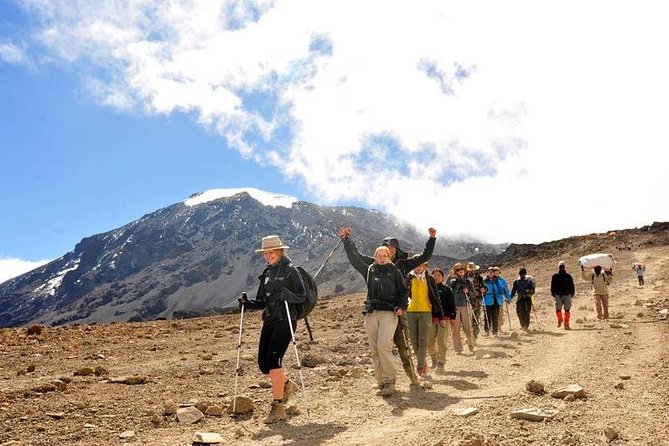
After the summit, the descent to Kibo is much faster than the ascent. You stop there for refreshments, then continue down to Horombo Hut. The full summit-to-Horombo day is listed at 13 to 15 hours.
One schedule line says 13 minutes, but that is clearly inconsistent with the stated 13 to 15-hour walking time. You should plan for the full day, not a short outing.
Day 7: descend through Mandara to Marangu Gate
The final mountain day takes you from Horombo down past Mandara Hut to Marangu Gate. The descent takes about six to seven hours.
Going down is easier on your breathing, but it can be hard on your knees and feet. After the long summit day, the trail may feel longer than expected. Use trekking poles if you have them, and keep your pace controlled.
At the gate, successful climbers receive summit certificates. You then transfer back to Kilimanjaro Mountain Resort for dinner and the night.
This overnight return to the resort is useful. It gives you a proper bed and a chance to recover before your flight. Do not plan an immediate airport departure after the mountain descent unless the operator confirms that the timing is safe.
Day 8: airport transfer or extra plans
After saying goodbye to the guides, you receive the included private transfer from Moshi to Kilimanjaro International Airport.
The schedule also allows for a short safari or another activity if arranged separately. No specific safari is included in the price details, so treat that as an optional extension rather than part of the climb.
Your departure time matters. The mountain schedule can run slowly, and the final descent follows a long summit day. Give yourself plenty of time between leaving the resort and checking in for your flight.
Weather, timing, and the best months
January and February are listed as the warmest months, often with clearer mornings and evenings. August and September are also recommended periods for climbing.
March, April, and May bring long rains and are best avoided for this route. November usually brings shorter rains, but climbing can still be possible because it does not necessarily rain every day.
July may be colder, while November and December can be wetter. Weather changes quickly on Kilimanjaro, so the calendar is only part of the decision. Your clothing, pacing, and willingness to follow guide instructions matter just as much.
If you want the best odds of a clear summit morning, January, February, August, and September are the sensible starting points. Even then, mountain weather is never guaranteed.
Fitness, safety, and the operator’s communication
The activity calls for a moderate level of physical fitness, but the summit day is harder than that phrase may suggest. You should be comfortable walking for several hours on consecutive days and prepared for a final day lasting up to 15 hours.
The pre-climb medical and equipment check is useful. Make sure you use it to discuss any health concerns honestly. A good summit plan includes the option to turn around if your condition worsens.
Communication deserves attention. One reported account describes a pickup arriving 30 minutes late without advance notice, requiring the customer to contact the company. The operator apologized and said the problem would help improve its service.
That does not prove that your transfer will be late, but it is a good reason to confirm pickup times directly. Keep the company’s contact details available, and do not assume that a delay will be announced automatically.
The overall published score is 4.3 from nine ratings, a modest sample. I would treat that as useful but not decisive. Ask clear questions before departure, especially about gear, transfer timing, meal arrangements, guide support, and what happens if you cannot continue.
Who should book this climb?
I would consider this experience if you want the classic hut route, prefer a private group, and value airport transfers and a prepared mountain schedule. The extra Horombo night is a practical benefit for anyone who would rather not rush from Mandara to Kibo.
It suits someone with moderate to good fitness who understands that reaching Uhuru depends on altitude tolerance as much as leg strength. You should be ready for basic huts, no running water at Kibo, long walking days, and a pre-midnight summit start.
I would hesitate if you want a relaxed holiday, hotel-level comfort, or a short summit walk. I would also compare the price with other operators if the details of porters, equipment, and guide ratios are not clearly explained before booking.
Free cancellation is available if you cancel at least 24 hours before the start time. Changes made inside that window are not accepted, and poor weather may lead to a different date or a full refund.
Should you book the Marangu Route climb?
Book it if the hut accommodation, included transfers, private format, and extra acclimatization night match what you need. The route offers a clear progression from rainforest to volcanic summit, with the major benefit of sleeping indoors rather than camping.
Before paying $1,950, confirm every inclusion in writing and verify the pickup plan. Most importantly, make sure you are choosing this for the mountain challenge, not because the word six days makes it sound short. The actual experience takes about eight days from airport arrival to departure, and the summit day is the hardest part by a wide margin.
FAQ
How long does the full experience last?
The full program lasts about eight days, including arrival, the mountain climb, the return night at Kilimanjaro Mountain Resort, and departure. The Marangu mountain section itself is described as six days.
Where does the climb begin and end?
The climb begins and ends at Kilimanjaro Mountain Resort in Marangu. Airport transfers connect the resort with Kilimanjaro International Airport.
Is airport transportation included?
Yes. A private transfer from Kilimanjaro International Airport to the resort is included on arrival, and a private departure transfer from Moshi to the airport is also included.
Where do you sleep on the mountain?
You sleep in huts at Mandara Hut, Horombo Hut, and Kibo Hut. The first and final nights are at Kilimanjaro Mountain Resort.
Is there an acclimatization day?
Yes. Day 4 includes a shorter walk toward Mawenzi Hut and the Zebra Rocks, followed by another night at Horombo Hut for additional acclimatization.
How long is the summit day?
The walk from Kibo Hut to the summit and back to Horombo Hut takes about 13 to 15 hours. It begins before midnight and includes the ascent to Gillman’s Point and, for those continuing, Uhuru Peak.
What happens if the weather is poor?
If the experience is canceled because of poor weather, you are offered a different date or a full refund. The operator’s cancellation terms allow a full refund when you cancel at least 24 hours before the start time.
More Kilimanjaro treks from Moshi
- Kilimanjaro climb, Lemosho Route (6-day)
★ 5.0 · 129 reviews - 7 Days Kilimanjaro via Machame route affordable price
★ 5.0 · 110 reviews - Kilimanjaro climb, Marangu route (6-day)
★ 5.0 · 72 reviews - Kilimanjaro Lemosho Route
★ 5.0 · 71 reviews
Just added in Moshi
- Wildlife Extravaganza: Manyara, Tarangire & Ngorongoro in 3 Days★ 5.0 · 3 reviews
- West Kilimanjaro cycling Adventures★ 4.5 · 8 reviews
- machame route★ 5.0 · 16 reviews
- Kilimanjaro Climb • Machame Route ~ 10 Day★ 5.0 · 6 reviews
- Kilimanjaro Climbing Umbwe Route★ 5.0 · 3 reviews
- Mt Kilimanjaro 6 days Marangu route hike★ 5.0 · 3 reviews
- 3 Days Private E-Bike Tour in West Kilimanjaro★ 5.0 · 3 reviews
- Private Cycle to Kilimanjaro Bike Park Safari★ 5.0 · 6 reviews
Kilimanjaro Treks, compared.



8-Day Small-group Lemosho Kilimanjaro Summit Trekking
Read our review →

5 Days Best of Tanzania Luxury Safari Northern Circuit
Read our review →

Climbing Kilimanjaro through 7 days Machame Route
Read our review →
7-Day Machame Kilimanjaro Summit Tour from Arusha
Read our review →Browse the lists this tour appears in