
Reviewed · KILIMANJARO TREKS
Kilimanjaro 360° 9 days Tour
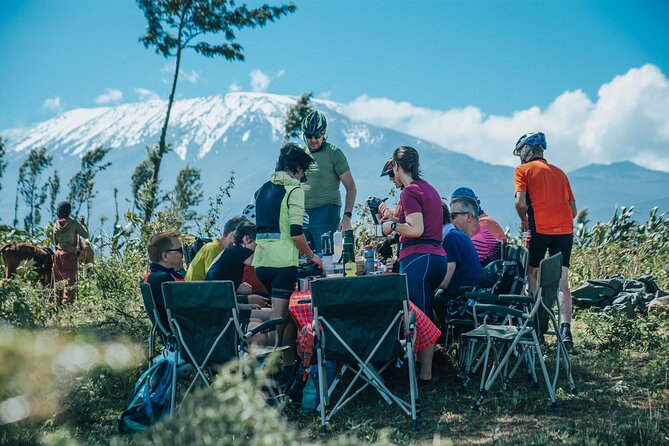
Kilimanjaro 360° is not a standard sightseeing loop. It is a demanding mountain-bike journey around Africa’s highest peak, linking Chagga villages, Maasai country, forests, farms, and open plains that most visitors never see from a safari vehicle. You will ride dirt, gravel, rocky tracks, and muddy roads, with views toward Kilimanjaro, Mount Meru, Mount Ol Doinyo Lengai, and Kenya.
I like the way the route connects several sides of the mountain instead of repeating one trail. I also like the practical setup: a supporting vehicle follows the cycling group, and the price includes a bike, helmet, meals, water, snacks, and transfers. The trade-off is clear: this is for people with a strong fitness level, not casual cyclists looking for an easy holiday.
Key things to know before you book
- A true mountain circuit: You ride through Machame, Shira, Rongai, Lake Chala, Uru, and Mweka rather than simply cycling near Moshi.
- Two demanding sections: The climb to the Shira Plateau reaches about 3,700 meters, while the forest route on Day 7 brings repeated uphill and downhill riding.
- Culture is part of the route: You pass through Chagga farming country and spend a night in a traditional Maasai hut at Olpopongi.
- A support vehicle follows the ride: This adds practical help on a long, remote route and gives the tour more flexibility.
- Meals and basic equipment are included: The package covers a mountain bike, helmet, water, snacks, nine lunches, eight breakfasts, and seven dinners.
- Private and adaptable: Only your group takes part, and One Bike has adapted shorter or faster versions of the route for cyclists with different plans.
What the nine-day Kilimanjaro circuit is really like
The tour costs $2,499 per person and lasts about nine days. That price makes more sense when you look at what is packed into the trip: airport or arrival transfer, hotel transfers, a private guide, support vehicle, bicycle, helmet, campsite and lodge nights, and most meals.
You are not paying only for a bike rental. You are paying for route planning across rough mountain roads, vehicle support, food arrangements, and a private itinerary that crosses several different parts of the Kilimanjaro region. Still, you should compare the cost with your own plans for lodging, insurance, flights, and extra meals. Those are not included.
The ride begins and ends at One Bike Shop on Mailimoja Road in Moshi. Pickup is offered from Kilimanjaro Airport or another arrival point, and the opening hours listed for the meeting point are 9:00 a.m. to 6:00 p.m. The tour is private, so you ride with your own group rather than joining a large cycling convoy.
Other routes up the mountain from Moshi:
- Kilimanjaro climb by Lemosho Route (7-day)
★ 5.0 · 651 reviews - Kilimanjaro climb, Machame Route (7-day)
★ 5.0 · 262 reviews - Kilimanjaro Climbing Lemosho Route 8 Days.
★ 5.0 · 186 reviews
Day 1: A calm start in Moshi
Your first day is mainly about arrival and preparation. A One Bike guide meets you at Kilimanjaro Airport or another agreed arrival point, then takes you to your hotel in Moshi.
You receive information about the route and prepare for the ride. That matters here, since the trip changes quickly from city roads to forest tracks, rocky climbs, and remote dirt roads. Use the remaining time to rest or explore Moshi, but do not treat this as a sightseeing-heavy day. Saving your energy is the sensible choice.
The city is also the practical place to settle your equipment and make sure you are comfortable with the bicycle before the long route begins.
Day 2: From Machame forest to Maasai country
After breakfast, you transfer to Machame Gate, the starting point for the cycling route. The first riding takes you along dirty and gravel roads through rain forest, banana plantations, coffee plantations, and homes associated with the Chagga people.
This opening section gives you a useful sense of how quickly Kilimanjaro’s surroundings change. The mountain is not only a high summit. It is also farmland, forest, villages, and working communities. You get a closer look at daily life than you would from a sealed vehicle window.
As you head west, the forest gives way to more open plains and acacia woodland. The cultural setting changes too, with Maasai communities and villages such as Ngabobo and Tinga Tinga along the way. You ride near the edge of the national park, crossing routes and native areas used by local wildlife.
The overnight stay is at Olpopongi Maasai village, in a traditional Maasai hut. That is one of the more distinctive parts of the itinerary, though you should expect a basic night rather than hotel comfort. The appeal is the setting and cultural contact, not polished facilities.
Day 3: Open plains and a wildlife corridor
Day 3 takes you across the Sinya and Ngasurai open plains. These areas function as a wildlife corridor between Kenya’s Amboseli National Park and Tanzania’s Enduimet wildlife management area.
That makes this one of the most memorable days for scenery, but it also explains why you need to respect the guide’s instructions. You are riding through an area used by animals, not on a closed recreational bike path. Wildlife sightings are not guaranteed, but the route itself gives you a more direct connection to the region’s natural spaces.
There is no tarmac on this section. You ride completely off the main paved routes, so surface conditions can affect your speed and comfort. On a clear day, you may see Kilimanjaro, Mount Meru, and Mount Ol Doinyo Lengai. The wide views are the reward for the rough riding.
You spend the night at Simba Farm campsite. Camping adds to the outdoor character of the trip, but it also means you should be ready for simpler facilities and a full day of physical effort.
Same base, a different kind of day out:
- Safari Serengeti And Ngorongoro
★ 5.0 · 288 reviews - Climbing Kilimanjaro – Machame Route
★ 5.0 · 170 reviews - Climbing Kilimanjaro through 7 days Machame Route
★ 5.0 · 151 reviews - Kilimanjaro climb, Lemosho Route (8-day)
★ 5.0 · 148 reviews
Day 4: The hard climb to Shira Plateau
This is the tour’s major cycling test. You climb along a dirty, rocky road toward the Shira Plateau, one of Kilimanjaro’s three main summit areas.
The route reaches a helipad at about 3,700 meters. At that height, the climb is not just a matter of leg strength. The altitude adds another challenge, and the rocky surface can make progress slow. A strong fitness level is essential, and this is the day when an honest assessment of your cycling ability matters most.
At the high point, you get views toward Kibo, Kilimanjaro’s snow-covered summit area, with Maasai country spreading out on the other side. After a rest, the return ride to Simba Farm is much easier because it is downhill.
The support vehicle is especially useful on a day like this. It gives the group practical backup during a long climb and allows the itinerary to be handled more flexibly. The route is private, so your guide can focus on your group’s condition rather than keeping pace with a large tour.
Day 5: Villages and the Rongai side
After the exposed high country, the route turns toward Kilimanjaro’s northeastern side along the Kenyan border. You pass through villages and farmland before finishing near the entrance to the Rongai trekking route at Nalemoru village.
Nalemoru sits beside the Rongai forest, a conservation area with many tree species. This section adds another ecological layer to the circuit. You are no longer seeing only open plains and high mountain views. You are moving through cultivated areas and forest edge communities.
The night is at Snow Cap Cottages in Rongai Village. After the campsite at Simba Farm and the basic hut at Olpopongi, a cottage stay may feel like a welcome reset. It also breaks up the tour’s outdoor rhythm before the next day’s descent.
Day 6: A gentler ride to Lake Chala
Day 6 is designed as a recovery day after the demanding climb and high-country riding. The route heads downhill toward Lake Chala, a caldera lake fed by underground springs from Mount Kilimanjaro.
Lake Chala is a strong change of pace. You have time to enjoy the water, surrounding forest, plants, and birdlife rather than simply passing through on the bicycle. It is a place to slow down and let your legs recover.
You spend the night beside the lake. The exact balance between riding and free time can depend on the group and conditions, but the purpose of this day is clear: less strain, more time in one setting. If you want every day to be a maximum-effort cycling challenge, this may feel slow. If you value variety and recovery, it is well placed.
Day 7: Mud, forest, and repeated climbs
The easier pace does not last. Day 7 returns to demanding riding on dirt and sometimes muddy roads, with plenty of uphill and downhill sections.
You go into dense forest, where the scenery changes again. The route is less about grand open views and more about the forest itself, including its plant life and animal habitat. Wet conditions can make this day much harder than the distance alone suggests.
The finish is at Kahawa Shambani campsite in Uru village. By this point, you will have experienced several kinds of riding: gravel, rock, loose dirt, forest tracks, and possible mud. That variety is a major strength of the circuit, but it also means you need to be comfortable with changing conditions.
Day 8: Mweka Gate and the final ride to Moshi
The final cycling day begins with another uphill route toward Mweka Gate. After circling the mountain, you return to Moshi on an easier tarmac road.
That last paved stretch will probably feel luxurious after the rough tracks. You have earned the relaxed finish, though the uphill approach to Mweka means this is not an easy day from the start.
Back in Moshi, dinner and time in town are included in the plan. You can rest, enjoy the city’s nightlife, or simply have a quiet evening. After eight days of cycling, most people will appreciate having a choice rather than another fixed activity.
Day 9: Rest, transfer, and departure
The final day is deliberately simple. You sleep and rest at your hotel, then transfer from Moshi to the airport or another departure point.
This extra night and departure day make the schedule less rushed. It also gives you room to recover before a flight, which is sensible after a physically demanding route.
Food, equipment, and support
The package includes a mountain bike and helmet, water, snacks, and a supporting vehicle. It also includes nine lunches, eight breakfasts, and seven dinners.
The meal count reflects the nine-day structure, but you should still check exactly what is served and what extra drinks or snacks may cost. The tour description emphasizes local food, which fits the cultural side of the journey and gives you a chance to eat in a way connected to the places you pass through.
The bike is central to the experience, so take the first day seriously. Ask the guide to confirm the bike setup, helmet fit, and any adjustment needed before you leave Moshi. The route has enough steep, rocky, and muddy riding that comfort and control matter.
Insurance, flights, and airport or departure taxes are not included. You need your own travel insurance, and this is especially important for a private cycling trip with high-altitude riding and rough roads.
Fitness, weather, and practical limits
You should have a strong physical fitness level for this tour. The key issue is not only total distance. The route includes sustained uphill riding, a climb to about 3,700 meters, rocky tracks, dirt roads, possible mud, and several days in succession.
The listed route can also be adapted. One Bike has arranged shorter versions, including a five-day circuit, and a very ambitious two-day version for a cyclist who wanted a tougher challenge. That does not mean you should assume every itinerary can be changed at the last minute. It does show that the company has experience adjusting plans to fit different goals.
Weather can affect the experience, particularly on unpaved roads and in the forest. If poor weather causes cancellation, you are offered another date or a full refund. Otherwise, free cancellation is available up to 24 hours before the start time. Changes made less than 24 hours ahead are not accepted, and the cutoff uses local time.
What makes One Bike a good fit
The strongest part of this experience is the way cycling connects with local life. You move through Chagga farming areas, Maasai villages, Kenyan border country, wildlife corridors, forest, and mountain routes in one continuous trip.
One Bike also has a community-minded side, with bike donations and recycling awareness mentioned as part of its work in Moshi. That does not replace the need to judge the tour on safety, equipment, and route planning, but it gives the company’s local presence more substance than a simple rental desk.
The team has also adapted plans for different cyclists. One cyclist used a shortened five-day version, while another planned an intense two-day challenge with a support vehicle. For this nine-day route, the private format is useful because your guide can work with your group’s pace and condition.
Should you book this Kilimanjaro bike tour?
Book it if you want an active, close-to-the-ground way to experience Kilimanjaro and you are comfortable with rough roads, simple overnight stays, and long days in the saddle. The mix of villages, wildlife corridors, mountain views, forests, Lake Chala, and Maasai country gives you much more variety than a straightforward cycle near Moshi.
Think twice if you want a relaxed holiday, smooth cycle paths, or guaranteed wildlife sightings. The $2,499 price is reasonable for a private nine-day trip with a support vehicle, meals, equipment, and transfers, but you still need to budget for flights, insurance, taxes, and any extras.
For a fit cyclist who values local contact and does not mind earning the views, this is a strong choice. The best reason to book is not simply reaching the mountain. It is seeing how many different worlds surround it.
FAQ
How long is the Kilimanjaro 360° cycling tour?
The tour lasts approximately nine days, including arrival, eight cycling days or riding stages, and the final departure day.
Where does the tour start?
The meeting point is One Bike Shop on Mailimoja Road in Moshi, Tanzania. Pickup is also offered from Kilimanjaro Airport or another arrival point.
Where does the tour finish?
The activity ends back at the meeting point in Moshi. A transfer to the airport or another departure point can be organized on Day 9.
Is this a private tour?
Yes. Only your group participates in the activity.
What equipment is included?
A mountain bike and helmet are included. Water, snacks, and a supporting vehicle are also provided.
Are meals included?
Yes. The package includes nine lunches, eight breakfasts, and seven dinners.
How physically demanding is the route?
You should have a strong physical fitness level. The route includes steep and rocky climbs, dirt and gravel roads, possible muddy sections, and a climb to approximately 3,700 meters at the Shira Plateau.
Are flights and insurance included?
No. Flight tickets, insurance, and airport or departure taxes are not included.
What happens if bad weather cancels the tour?
If poor weather causes cancellation, you are offered a different date or a full refund. You can also cancel up to 24 hours before the start time for a full refund.
More Kilimanjaro treks from Moshi
- Kilimanjaro climb, Lemosho Route (6-day)
★ 5.0 · 129 reviews - 7 Days Kilimanjaro via Machame route affordable price
★ 5.0 · 110 reviews - Kilimanjaro climb, Marangu route (6-day)
★ 5.0 · 72 reviews - Kilimanjaro Lemosho Route
★ 5.0 · 71 reviews
Just added in Moshi
- Wildlife Extravaganza: Manyara, Tarangire & Ngorongoro in 3 Days★ 5.0 · 3 reviews
- West Kilimanjaro cycling Adventures★ 4.5 · 8 reviews
- machame route★ 5.0 · 16 reviews
- Kilimanjaro Climb • Machame Route ~ 10 Day★ 5.0 · 6 reviews
- Kilimanjaro Climbing Umbwe Route★ 5.0 · 3 reviews
- Mt Kilimanjaro 6 days Marangu route hike★ 5.0 · 3 reviews
- 3 Days Private E-Bike Tour in West Kilimanjaro★ 5.0 · 3 reviews
- Private Cycle to Kilimanjaro Bike Park Safari★ 5.0 · 6 reviews
Kilimanjaro Treks, compared.



8-Day Small-group Lemosho Kilimanjaro Summit Trekking
Read our review →

5 Days Best of Tanzania Luxury Safari Northern Circuit
Read our review →

Climbing Kilimanjaro through 7 days Machame Route
Read our review →
7-Day Machame Kilimanjaro Summit Tour from Arusha
Read our review →Browse the lists this tour appears in