
Reviewed · KILIMANJARO TREKS
Kilimanjaro Climb – 6 Days Marangu Route
Kilimanjaro’s Marangu Route gives you a relatively short path to Africa’s highest point, with the unusual comfort of permanent sleeping huts instead of tents. You move from rainforest to moorland, then across a stark high-altitude desert before the hard night climb from Kibo Hut to Uhuru Peak.
I like the built-in acclimatization day at Horombo Hut, and I like that the $2,200 price includes airport transfers, park fees, three hot meals a day, guides, porters, safety equipment, and accommodation. The catch is clear: this is the shortest standard route, so the steep summit push and limited adjustment time make it a serious physical test.
Key points to know before you book
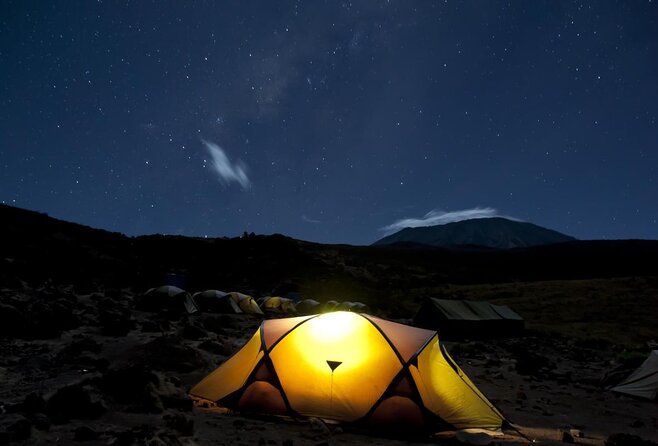
- Permanent huts at every mountain camp: You sleep indoors on the Marangu Route, a useful advantage in wet or cold conditions.
- One full acclimatization day: Day three at Horombo gives your body extra time to adjust before Kibo.
- A demanding summit night: The climb from Kibo Hut begins in darkness and takes 6 to 8 hours to reach the summit area.
- The same route up and down: Marangu is the only Kilimanjaro route using the same trail in both directions, which can mean more traffic.
- A strong support team: Guides Alex, Rafael, and Manme received special praise, while chef King was noted for keeping the group well fed.
- A private experience: Only your group participates, with pickup from Kilimanjaro International Airport included.
Why the Marangu Route remains popular
The Marangu Route is often called the Coca Cola Route because it is the most direct and familiar way up Kilimanjaro. Its main appeal is simple: you can reach the summit in six climbing days, and you sleep in permanent huts at Mandara, Horombo, and Kibo.
That sounds easier than camping, but do not confuse comfort with an easy climb. The route rises quickly. You gain about 950 meters on the first day, another 1,030 meters on the second, and then reach Kibo Hut at 4,700 meters before the summit attempt.
Marangu also uses the same path for the ascent and descent. This makes route finding straightforward, but it gives the climb less variety and can create more foot traffic. Other Kilimanjaro routes offer different trails on the way down, while Marangu keeps the focus on efficiency.
I would choose this route if your time is limited and hut accommodation matters to you. I would be cautious if your main goal is to give yourself the best possible acclimatization schedule. The extra day at Horombo helps, but six days is still a compact plan for a mountain this high.
Other routes up the mountain from Moshi:
- Kilimanjaro climb by Lemosho Route (7-day)
★ 5.0 · 651 reviews - Kilimanjaro climb, Machame Route (7-day)
★ 5.0 · 262 reviews - Kilimanjaro Climbing Lemosho Route 8 Days.
★ 5.0 · 186 reviews
Arrival in Moshi and the pre-climb briefing
Your trip begins with pickup at Kilimanjaro International Airport and transfer to your hotel in Moshi. The package includes private airport transport and accommodation, though meals and drinks at the hotel before and after the climb are not included.
A head guide meets you for a briefing about Kilimanjaro and the Marangu Route. This is also when the team checks your gear and arranges rental equipment if you need it. Take this part seriously. A gear check is not just a formality when you are preparing for rain in the forest, cold at Kibo, and a long summit night.
The operation is private, so only your group participates. That gives the guide team room to adjust the pace and attention to your party rather than managing a mixed group of strangers.
The team includes professional mountain guides, a cook, and porters. Portable oxygen tanks, an oximeter, and an emergency first-aid kit are included. Those items do not remove the risks of high altitude, but they show that basic mountain safety equipment is part of the arrangement.
Day 1: Marangu Gate to Mandara Huts
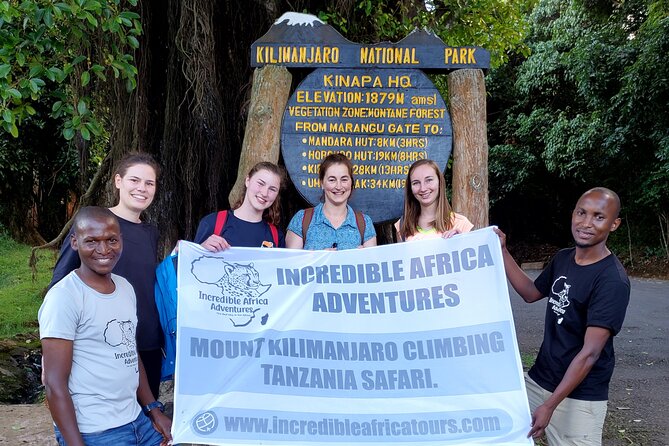
The first day covers 7 kilometers in about 4 to 5 hours, with an altitude gain of 950 meters. You start at Marangu Gate and climb through rainforest to Mandara Huts at 2,750 meters.
This is one of the most pleasant sections of the route. The forest gives you shade, and the gradual trail lets you settle into a walking rhythm. It is also the day when excitement can cause people to walk too quickly. Keep your pace steady and conserve energy.
You sleep at Mandara Hut rather than in a tent. That is a real advantage if wet weather arrives, and it makes the first night feel more organized than a standard camping setup. Still, the hut does not make altitude disappear. Pay attention to how you feel and follow your guide’s instructions.
Your first day is short enough on paper, but the gain is meaningful. You are already moving from the lower slopes into the mountain’s high zones. Good pacing now matters later.
Day 2: Mandara Huts to Horombo Huts
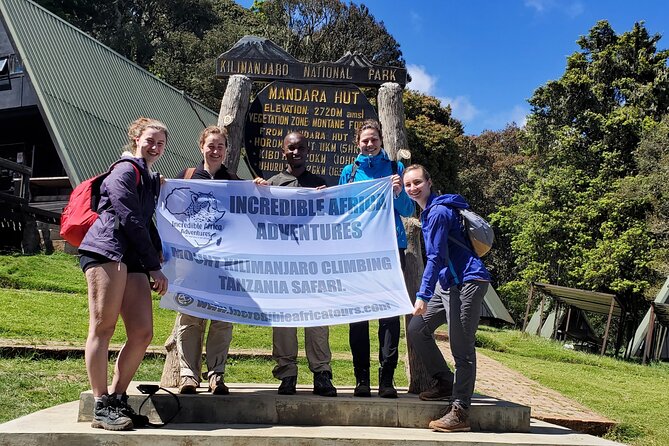
Day two covers 11 kilometers in 5 to 6 hours. You gain another 1,030 meters and finish at Horombo Hut, at 3,780 meters.
The forest thins as you move toward moorland. The change in vegetation is one of the rewarding parts of the climb. You can feel the mountain opening up around you, while the air becomes cooler and thinner.
Horombo is an important stop because it is both a camp and your base for the next two nights. Arriving here is a useful checkpoint. You have made a large altitude gain in two days, and the following rest day is a major part of the itinerary rather than wasted time.
This is also where the Marangu schedule begins to show its limits. You have climbed high quickly, and your body has not had much time to adjust. Walk slowly, drink as directed by your guides, and do not treat feeling strong at this stage as proof that the summit will be easy.
Same base, a different kind of day out:
- Safari Serengeti And Ngorongoro
★ 5.0 · 288 reviews - Climbing Kilimanjaro – Machame Route
★ 5.0 · 170 reviews - Climbing Kilimanjaro through 7 days Machame Route
★ 5.0 · 151 reviews - Kilimanjaro climb, Lemosho Route (8-day)
★ 5.0 · 148 reviews
Day 3: A full acclimatization day at Horombo
Day three is the most valuable feature of this six-day plan. You rest at Horombo and take short guided hikes around the area to help with acclimatization.
You are given time to recover, but the day is not simply a day in bed. Short walks provide gentle activity while allowing you to spend more time at altitude. This gives your body a better chance to adjust before the route climbs toward Kibo.
I like this pause because it breaks up the fast upward movement. A six-day climb cannot offer the same adjustment time as a longer route, so the full day at Horombo matters. It also gives you a chance to assess your condition before the next major push.
Do not spend the day trying to prove your fitness. The aim is to arrive at Kibo Hut ready for the summit attempt. Rest, eat the hot meals provided by the cook, and speak plainly with your guide if you have symptoms of altitude sickness.
Day 4: Horombo to Kibo Hut across the high desert
Day four covers 12 kilometers in roughly 5 to 6 hours. You gain 920 meters and sleep at Kibo Hut, at 4,700 meters.
The route leaves the moorland behind and crosses a much barer high-altitude zone. This section feels more exposed and austere than the rainforest below. There is less visual softness, and the main task is to reach Kibo while keeping enough energy for the night ahead.
Kibo Hut is the launch point for the summit. You do not have a long evening here. The schedule requires rest before the climb begins, so use the time to eat, organize clothing, check personal items, and listen carefully to the guide’s instructions.
At 4,700 meters, sleep may be difficult. That is normal for a high camp, but the altitude can affect people differently. The important point is that Kibo is not just another overnight stop. It is where you prepare for the toughest section of the entire trip.
Day 5: Kibo Hut to Uhuru Peak and back to Horombo
Summit day begins with a 6 to 8 hour climb covering about 7 kilometers and gaining 1,145 meters. The route is steep, and it usually starts at night so you can reach the summit area in the morning.
You pass Gilman’s Point on the way toward Uhuru Peak. The climb is slow and demanding, with the altitude making every step harder than the distance suggests. This is the moment when the route’s short schedule becomes most noticeable. You have reached 4,700 meters after only a few days, and now you must gain more than 1,100 meters.
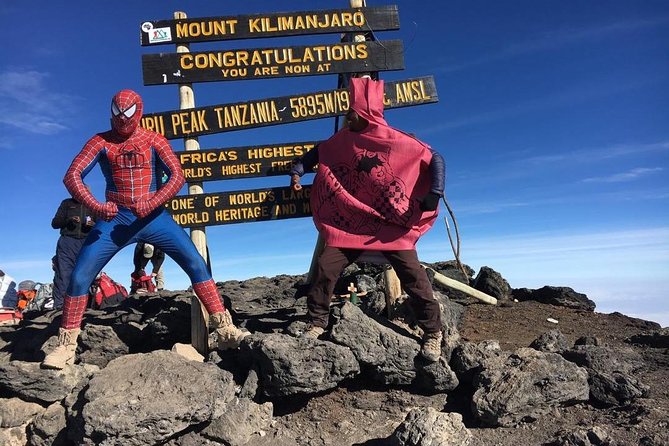
The plan allows a short time at the Roof of Africa before beginning the descent. Do not expect a long, relaxed summit visit. Cold, fatigue, and altitude all make the summit stop brief, but the view from Uhuru Peak is the defining reward of the climb.
The descent from the summit to Horombo takes another 5 to 6 hours over 12 kilometers, with an altitude loss of 2,175 meters. This is an exceptionally long day. Reaching the summit is only half the work; you still need to descend to a lower camp.
This is where strong guide support matters most. The team members Alex, Rafael, and Manme were singled out for being caring and attentive, and that kind of steady supervision is valuable during a long summit day. The support team also includes a cook, with King receiving special praise for keeping meals coming throughout the climb.
You should expect to be exhausted when you reach Horombo. The hut is welcome not because it feels luxurious, but because it gives you an indoor place to recover after the hardest day.
Day 6: Horombo Huts to Marangu Gate
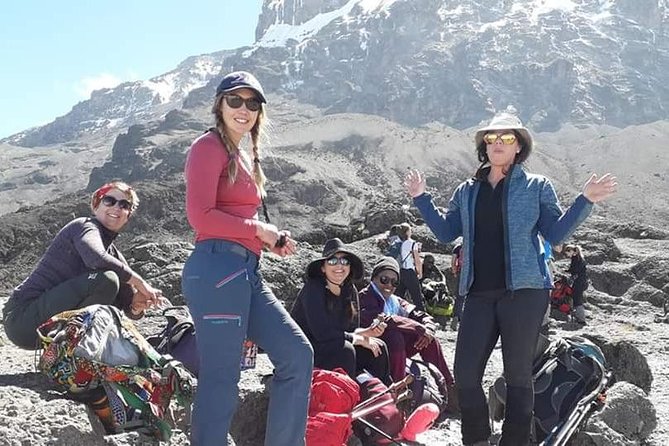
The final day covers 18 kilometers in 5 to 7 hours, with an altitude loss of 1,878 meters. You retrace the route through the lower mountain zones and finish at Marangu Gate.
The long descent can be tough on tired knees, even though the altitude is now helping you breathe more easily. The changing vegetation gives the return walk some variety, but this is mainly a day of steady movement toward the finish.
At Marangu Gate, you receive your Kilimanjaro summit certificate. You are then transferred back to your hotel in Moshi or Arusha.
The itinerary describes the full day as 18 kilometers, so do not plan an ambitious evening after returning. Give yourself time to shower, eat, and recover. Lunches, dinners, and drinks at the hotel are not included, so budget separately for those costs.
What the $2,200 price covers
At $2,200 per person, this is not a bare trail fee. The price includes private transport to and from Kilimanjaro Airport, accommodation, park fees, taxes, three hot meals daily on the mountain, professional guides, a cook, porters, portable oxygen, an oximeter, and an emergency first-aid kit.
That package has real value because Kilimanjaro costs are not limited to park entry. Food, staff, transport, and mountain support all add up. The inclusion of porters and a cook also means you are not carrying every camp supply or preparing your own meals after a long day.
You still need to budget for travel insurance, personal items, toiletries, hotel meals and drinks, and tips for the guides, porters, and cook. Travel insurance is especially important for a high-altitude trip. The price should be judged alongside those additional costs, not treated as the final amount you will spend.
The six-day schedule also gives the price a practical angle. You spend fewer days on the mountain than you would on a longer route, which may reduce the total cost of time away from home. The tradeoff is less acclimatization and a lower margin for error at altitude.
The guide and support team
The people supporting you can shape the entire experience. Octavian is the key contact associated with Incredible Africa Adventures, and he has been praised for anticipating needs and adjusting the adventure to suit the group.
On the mountain, Alex, Rafael, and Manme were specifically praised for professional and caring support. That matters on a route where pace, rest, and clear decisions affect your summit chances.
The cooking team is another important part of the package. Chef King received special mention for keeping meals consistent during the climb. Three hot meals each day are included, which is a meaningful benefit when you are burning energy at altitude.
Porters handle much of the mountain transport, but you should still pack responsibly and respect the work involved. Ask the company about its porter practices before booking if that is important to you. The supplied information confirms that porters are part of the team, but it does not provide further details about wages or equipment.
Who should choose this six-day climb?
This climb suits you if you have limited time, want hut accommodation, and prefer a private group with organized support. The airport pickup is useful if you are arriving directly for the climb, and the included gear check gives you a clear starting point.
You need a strong level of physical fitness. The distances are manageable on the early days, but the total effort builds quickly. Day five is the real test, with the summit ascent followed by a long descent to Horombo.
I would not choose this route simply because it is called the easier or shorter option. Shorter means less time on the mountain, not less exertion. If you are unsure about your altitude preparation, ask the provider about longer route options before paying.
The route can also suit people who prefer huts to tents. Just keep expectations realistic. Permanent huts provide shelter, but they do not guarantee comfort or easy sleep at 4,700 meters.
Booking, cancellations, and practical details
Confirmation is received at booking, and the experience is listed near public transportation. Pickup is offered from Kilimanjaro International Airport, with transfers also provided after the climb to Moshi or Arusha.
You can cancel for a full refund up to 24 hours before the local start time. Changes or cancellations made inside that 24-hour window are not accepted for a refund. If bad weather forces cancellation, you are offered another date or a full refund. The same applies if the minimum number of participants is not reached.
The climb is private, but the exact group size is not stated. Ask before booking if you need that information. You should also confirm the hotel arrangements, rental gear costs, tipping guidance, and the company’s recommended insurance before departure.
Should you book the Marangu Route?
Book this six-day Kilimanjaro climb if you value hut accommodation, a private setup, airport transfers, and a direct route that fits a tight schedule. The support package is substantial, and the team structure includes guides, porters, a cook, safety equipment, and three hot meals each day.
Think twice if your priority is the highest possible summit success rate. The Marangu Route climbs quickly, uses the same trail in both directions, and gives you less time to adjust than longer routes. The full day at Horombo helps, but the summit night remains steep and demanding.
For a fit person with limited time, realistic expectations, and proper preparation, this is a practical way to attempt Kilimanjaro. Go in knowing that the huts make the nights simpler, not the mountain easier.
FAQ
How long is the Kilimanjaro Marangu Route experience?
The climb lasts approximately six days. The schedule includes arrival and hotel arrangements, five mountain trekking days, and one full acclimatization day at Horombo.
Where does the experience start?
The listed meeting point is Kilimanjaro International Airport in Tanzania. Private airport transport is included.
How high is the summit camp?
Kibo Hut, the camp used before the summit attempt, is at 4,700 meters. Uhuru Peak is reached the following day after a gain of about 1,145 meters.
Are meals included?
Three hot meals daily are included while you are on the mountain. Hotel lunches, dinners, and drinks before and after the climb are not included.
Do I sleep in tents?
The Marangu Route uses permanent sleeping huts at the campsites, including Mandara Hut, Horombo Hut, and Kibo Hut.
Is travel insurance included?
No. Travel insurance is not included in the price, so you need to arrange it separately.
Can I cancel for a full refund?
Yes. You can cancel at least 24 hours before the local start time for a full refund. Cancellations or changes made less than 24 hours before the start are not refunded.
Just added in Moshi
- Wildlife Extravaganza: Manyara, Tarangire & Ngorongoro in 3 Days★ 5.0 · 3 reviews
- West Kilimanjaro cycling Adventures★ 4.5 · 8 reviews
- machame route★ 5.0 · 16 reviews
- Kilimanjaro Climbing Umbwe Route★ 5.0 · 3 reviews
- Mt Kilimanjaro 6 days Marangu route hike★ 5.0 · 3 reviews
- Kilimanjaro Climb • Machame Route ~ 10 Day★ 5.0 · 6 reviews
- 3 Days Private E-Bike Tour in West Kilimanjaro★ 5.0 · 3 reviews
- Private Cycle to Kilimanjaro Bike Park Safari★ 5.0 · 6 reviews
Kilimanjaro Treks, compared.



8-Day Small-group Lemosho Kilimanjaro Summit Trekking
Read our review →

5 Days Best of Tanzania Luxury Safari Northern Circuit
Read our review →

Climbing Kilimanjaro through 7 days Machame Route
Read our review →
7-Day Machame Kilimanjaro Summit Tour from Arusha
Read our review →Browse the lists this tour appears in