
Reviewed · KILIMANJARO TREKS
Climb Mount Kilimanjaro: 7 Days Machame Route
The hard part comes before sunrise on day six, when you leave Barafu Camp for the long push to Stella Point and Uhuru Peak. This seven-day Machame Route climb gives you time to adjust to altitude while moving through rainforest, moorland, rocky high country, and the glaciers near Kilimanjaro’s summit.
I like the practical support: you have a guide, cook, porters, modern tents, warm sleeping pads, oxygen systems, and a pulse oximeter. I also like the route’s acclimatization plan, especially the high-altitude walk on day three followed by a night at a similar elevation.
The main catch is simple: this is a serious physical challenge, not a gentle scenic walk. The summit day can last about 13 hours, and personal gear, crew tips, international flights, insurance, and some hotel meals are not included in the $3,034 price.
Key points to know before you book
- The summit push begins around midnight to 2 am: You climb through scree toward Stella Point, then continue to Uhuru Peak before descending to Mweka Camp.
- Day three reaches about 4,600 meters: You climb high and sleep lower, an important part of adjusting to altitude.
- Your crew carries the camp and cooking equipment: Each climber receives porter support for up to 15 kilograms of personal gear.
- Barranco Wall adds a steep, tiring section: The climb is over rock but is described as nontechnical.
- The price covers major park and camp costs: Permits, rescue fees, camping fees, meals during the climb, tents, airport transfers, and sleeping pads are included.
- This is a private experience: Only your group takes part, with pickup offered and a stated start time of 8:00 am.
Why the Machame Route takes seven days
Kilimanjaro is not a technical mountain climb in the usual sense, but altitude makes it demanding. The Machame Route gains height steadily, then gives you several chances to walk high and sleep lower before summit night.
That extra time matters. A shorter itinerary may sound appealing, but you want your body to adjust before the final ascent. Here, day three reaches roughly 4,600 meters, while the camp that night sits at a similar height to your starting point. The point is not simply to cover ground. It is to prepare your body for the summit.
You will walk for several hours most days, with the summit day stretching to about 13 hours. The route includes forest trails, open moorland, rock, scree, and possible snow near the top. I would treat the stated walking times as useful planning estimates, not promises. Pace, weather, rest stops, and altitude can all affect the day.
Other routes up the mountain from Moshi:
- Kilimanjaro climb by Lemosho Route (7-day)
★ 5.0 · 651 reviews - Kilimanjaro climb, Machame Route (7-day)
★ 5.0 · 262 reviews - Kilimanjaro Climbing Lemosho Route 8 Days.
★ 5.0 · 186 reviews
Starting at Machame Gate in the rainforest
The first morning begins with transport from Moshi to Machame Gate, normally about an hour away. Airport pickup and hotel transfers are included, so the arrival process is less complicated than arranging each ride yourself.
At the gate, you meet the guide, cook, and porters. Park formalities take place while the crew sorts and assembles the equipment. This can feel busy, but it is an important part of the trip. The mountain camp has to be carried, cooked, and organized from the beginning.
The first trail section climbs through dense rainforest. Expect a steady uphill walk rather than a quick burst of effort. The day is listed at about six hours, and the forest offers a strong opening contrast to the bare upper slopes you will reach later.
This section is a good test of your preparation. Keep your pace controlled from the start. The mountain rewards patience, and there is little value in racing during the first few hours. Your guide and crew provide support, but you still need to manage your own water, clothing, and energy.
Shira Camp 2 and the first open views
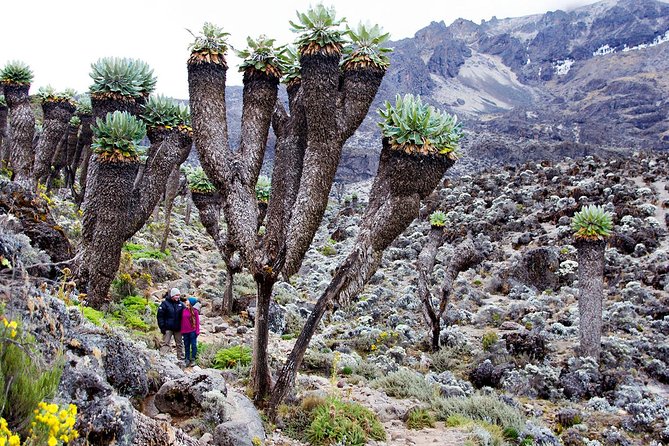
Day two leaves the forest and enters the low alpine zone. The surroundings change to moorland and grassland, with a more open feel and a steeper trail.
Shira Camp 2 sits on a plateau. From here, you get your first stated views of Kibo to the northwest and Mount Meru to the east. These views matter because they give you a better sense of the mountain’s scale. You are no longer simply walking uphill through trees. You can see the high point ahead and the wider volcanic setting around you.
The day takes about five hours. That may sound manageable, but the combination of incline and increasing altitude can make a shorter day feel demanding. Keep meals and warm layers easy to reach, and do not let the clear views tempt you into pushing too hard.
You share a tent with one or two other climbers during the trip. The tents are described as modern, and two-inch warm sleeping pads are provided. That is a useful inclusion at a mountain camp, where a thin pad can make a cold night much harder.
Day three: the important high-and-low routine
Day three crosses high moorland and reaches about 4,600 meters. It is one of the most important days for acclimatization because you climb high during the day but finish at roughly the same elevation where you began.
This pattern gives your body time to respond to altitude without forcing you to sleep at the day’s highest point. The walk lasts about six hours, and the surroundings become more exposed and stark as you leave the lower vegetation behind.
Altitude can change how a normal walk feels. You may notice that breathing takes more effort, your pace slows, or a small incline demands a break. The itinerary includes oxygen systems and pulse oximeters, but these are safety tools, not substitutes for careful pacing and honest communication with your guide.
This is also a day when the private format can help. Your group is not mixed with other booking groups, so the pace and rest pattern can be managed around your own party. The supplied information does not state a fixed group size, but it does confirm that only your group participates.
Same base, a different kind of day out:
- Safari Serengeti And Ngorongoro
★ 5.0 · 288 reviews - Climbing Kilimanjaro – Machame Route
★ 5.0 · 170 reviews - Climbing Kilimanjaro through 7 days Machame Route
★ 5.0 · 151 reviews - Kilimanjaro climb, Lemosho Route (8-day)
★ 5.0 · 148 reviews
Barranco Wall and Karanga Camp
Day four begins with a descent into the start of the Great Barranco, followed by the climb up Barranco Wall. This is one of the route’s most memorable physical sections.
The wall is climbed over rock and is described as nontechnical, but it is still long and tiring. You do not need a technical climbing system according to the supplied details, yet you should expect hands-on movement, steep steps, and a slower pace. A good guide matters here, especially when you are already feeling the effects of altitude.
After the wall, the route climbs from Karanga Valley to Karanga Camp at about 3,963 meters. The day is listed at four hours, but do not read that number as easy. The route profile includes a descent, a steep rock climb, and another uphill section.
I like the way this day breaks up the route. You gain and lose height instead of simply marching upward, which helps with acclimatization while giving you changing views of Kibo. The price is physical effort. You need to save energy for the following day and the summit push.
Barafu Camp and preparation for summit night
Day five takes you to Barafu Camp, the final high camp before the summit attempt. The walk is listed at about four hours.
By this point, you have completed the South Circuit, which provides views of the summit from several angles. That matters more than it may sound. Seeing Kibo from different sides helps you understand the route ahead, though it does not make the climb itself easier.
At Barafu, you eat dinner, rest, and prepare for a very early start. The supplied schedule gives a summit departure between midnight and 2 am. That means you should organize clothing, water, headlamp, and personal items before trying to sleep.
The camp arrangement includes a dining tent, tables, chairs, crockery, and a cook. Six breakfasts, six lunches, and six dinners are included during the climb, along with coffee or tea and bottled water. These basics save you from carrying cooking equipment and planning mountain meals yourself.
You still need to bring or rent personal gear. Gear rental is not included, and the supplied information does not list a complete packing kit. Ask for the current equipment list before arrival, especially for cold-weather clothing and summit conditions.
The 13-hour push to Uhuru Peak
Summit day is the heart of the trip and the part that demands the most honesty from you. The climb begins between midnight and 2 am, heading toward Stella Point between the Rebmann and Ratzel glaciers.
The route ascends through heavy scree. Scree is loose rock that shifts underfoot, so progress can be slow and tiring. The effort is described as the most mentally and physically challenging part of the trek. That is useful information, because the summit may look close while still requiring hours of work.
At Stella Point, you take a short rest and may see sunrise. Faster climbers may reach the summit in time for sunrise, but you should not treat that as a target. The safer approach is to follow your guide’s pace and focus on steady movement.
From Stella Point, the final ascent to Uhuru Peak takes about an hour, with possible snow along the way. Uhuru Peak is the highest point on Mount Kilimanjaro and the highest point in Africa. The summit itself may be brief. You will still need to descend, so take in the view, follow the crew’s instructions, and protect your energy.
After the summit, you descend toward Mweka. The full day is listed at about 13 hours. That figure includes both the long ascent and the descent, so the return is not an afterthought. Tired legs, loose ground, and altitude can make going down difficult in a different way.
Returning through the rainforest to Mweka Gate
Day seven is the final trekking day. You descend through rainforest to Mweka Gate, with about four hours of walking listed.
The lower forest feels like a clear change from the cold, exposed summit route. At the gate, you complete park formalities and receive international certificates for a successful ascent. You then spend the night at your arranged hotel, with breakfast included.
The return transfer to Kilimanjaro Airport is also included. This is helpful if your onward flight is already planned, though you should confirm the timing of the transfer against your flight schedule before booking.
What the $3,034 price covers
At $3,034, this is not a budget walk. It is a full supported climb with significant park and transport costs built in.
Included items cover accommodation before and after the climb in a shared twin room with breakfast, airport pickup, hotel transfers, trailhead transport, and airport return. During the climb, you share tents with one or two other climbers.
The mountain costs are also covered: Kilimanjaro National Park permits, rescue fees, camping or hut fees, modern tents, sleeping pads, meals, bottled water, coffee or tea, and a professional crew. Each climber has porters assigned to carry up to 15 kilograms of gear.
The safety and comfort equipment is a useful part of the value. Oxygen systems, pulse oximeters, a first aid kit, a dining tent, and group dining equipment are included. Portable flush toilets can also be provided at no extra charge if you request them.
Budget separately for personal gear rental, laundry, toiletries, and food and drinks at your Moshi hotel. International flights and travel insurance are also your responsibility. There is also a stated entry charge of $100 for US nationals and $50 for other nationalities, though you should confirm exactly how this charge applies before payment.
Crew gratuities are listed separately at $15 to $20 per day for the guide, $10 to $15 per day for the cook, and $8 to $10 per day for each porter. Since the crew is central to the trip, include these amounts in your real budget rather than treating them as optional surprises.
Who should book this climb
I would choose this trip if you want a private, supported Kilimanjaro climb with a longer schedule for altitude adjustment. The seven-day plan suits you if you prefer steady progress over a rushed ascent.
You should have a moderate level of physical fitness. That phrase should not be read as permission to arrive unprepared. The summit day is long, and the route includes steep climbing, high altitude, loose rock, cold conditions, and an early start.
This climb also suits you if you value practical support more than a stripped-down mountain experience. A cook prepares meals, porters carry much of the load, and the crew handles camp equipment. You still have to walk every step, manage your own personal gear, and cope with the altitude.
The small review sample gives the experience a 5 out of 5 rating, with special praise for the crew’s helpful, friendly, and supportive manner. That is the strongest human detail available here, and it points to the crew as a major part of the experience. No guide names are provided, so ask for the assigned guide’s name and experience before departure.
Final decision: a well-supported climb with a demanding summit day
Book this Machame Route trip if you want a seven-day schedule, private group arrangements, included airport transfers, and a crew that handles food, camp, and much of the heavy equipment. The included permits, rescue fees, meals, sleeping pads, tents, and oxygen systems give the $3,034 price real substance.
Do not book it because the package sounds comfortable. Tents and warm pads help, but they do not remove the cold, altitude, steep rock, or 13-hour summit day. If you prepare properly, pace yourself, and budget for gear, insurance, and crew tips, this offers a practical route to Uhuru Peak with strong support around you.
FAQ
Where does the climb begin?
The trek begins at Machame Gate, normally about one hour from Moshi by road.
How long is the experience?
The climb lasts approximately seven days, including the final descent to Mweka Gate and an overnight stay at the arranged hotel.
What time does the tour start?
The stated start time is 8:00 am. The summit section begins much earlier, between midnight and 2 am on day six.
Is airport pickup included?
Yes. Pickup from Kilimanjaro International Airport, hotel transfers, transport to the trailhead, and return transport to the airport are included.
Is this a private tour?
Yes. Only your group participates in the activity.
How much gear can each porter carry?
Each climber is provided porter support for up to 15 kilograms of gear.
Are meals included during the climb?
Yes. Six breakfasts, six lunches, and six dinners are included during the climb, along with bottled water and coffee or tea.
Are tents and sleeping pads provided?
Yes. Modern tents and warm sleeping pads described as two inches thick are included. You share a tent with one or two other climbers.
Is a vegetarian meal available?
Yes. You should request the vegetarian option when booking.
What is the cancellation policy?
You can receive a full refund if you cancel at least 24 hours before the experience start time. Cancellations or changes made within 24 hours are not accepted for a refund.
Just added in Moshi
- Wildlife Extravaganza: Manyara, Tarangire & Ngorongoro in 3 Days★ 5.0 · 3 reviews
- West Kilimanjaro cycling Adventures★ 4.5 · 8 reviews
- machame route★ 5.0 · 16 reviews
- Kilimanjaro Climb • Machame Route ~ 10 Day★ 5.0 · 6 reviews
- Kilimanjaro Climbing Umbwe Route★ 5.0 · 3 reviews
- Mt Kilimanjaro 6 days Marangu route hike★ 5.0 · 3 reviews
- 3 Days Private E-Bike Tour in West Kilimanjaro★ 5.0 · 3 reviews
- Private Cycle to Kilimanjaro Bike Park Safari★ 5.0 · 6 reviews
Kilimanjaro Treks, compared.



8-Day Small-group Lemosho Kilimanjaro Summit Trekking
Read our review →

5 Days Best of Tanzania Luxury Safari Northern Circuit
Read our review →

Climbing Kilimanjaro through 7 days Machame Route
Read our review →
7-Day Machame Kilimanjaro Summit Tour from Arusha
Read our review →Browse the lists this tour appears in