
Reviewed · KILIMANJARO TREKS
Kilimanjaro Northern Circuit Route 8 Days
The Northern Circuit is Kilimanjaro’s longest route, and that is its main appeal. You start on the Lemosho side, cross the high Shira Plateau, then leave the busier trails to circle the mountain’s northern slopes before climbing toward Uhuru Peak. The route gives you more time to adjust to altitude and a quieter mountain experience.
I like the private-tour format and the serious safety setup, including emergency oxygen, a Gamow bag, medical monitoring, and a guide trained in wilderness first response. I also like the small comforts: hot washing water, warm towels, a private flush toilet, large meals, and even wine and champagne for the summit celebration.
The main drawback is the price and the demanding length. At $3,000 per person, this is not a budget climb, and the final summit day can last 13 to 16 hours. The extra acclimatization helps, but it does not make Kilimanjaro easy.
Key points to know before booking
- Eight days on the mountain: You get a gradual route with six hiking days before the summit push and a final descent through Mweka forest.
- A quieter northern traverse: After the Shira Plateau, you leave the main western route and cross remote valleys below Kibo.
- A private experience: Only your own group takes part, with group discounts available.
- Strong safety provisions: The package includes emergency oxygen, a Gamow bag, a pulse oximeter, vital sign checks, a medical kit, and AMREF Flying Doctors evacuation cover.
- A full-service camp: Tents, mattresses, a mess tent, private portable toilet, purified water, hot washing water, meals, and porters are included.
- The hardest day is very hard: You leave around midnight, reach 5,895 meters, then descend to 3,100 meters in one long push.
Why the Northern Circuit earns eight days
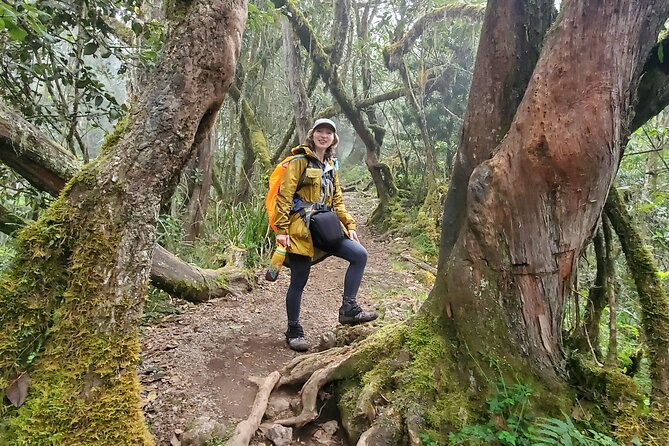
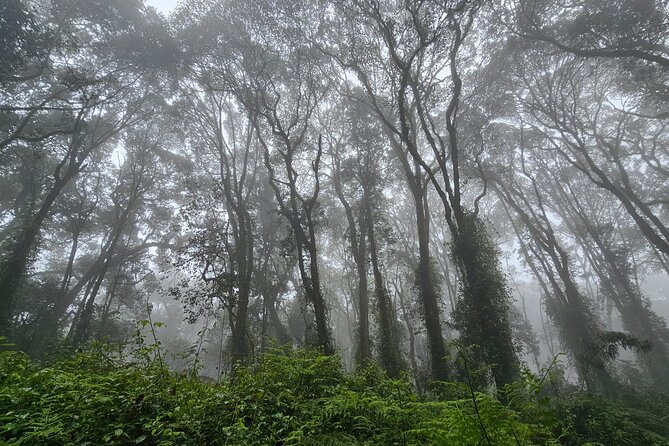
Kilimanjaro has several routes, but the Northern Circuit takes the long way around the mountain. You begin from the western side on the Lemosho approach, then cross the Shira Plateau and turn north. From there, you walk through remote valleys below Kibo before joining the final route to the summit.
That extra time matters. Altitude is the main reason people fail to reach the top, not simply fitness. This route lets you spend more nights at high elevation and gain altitude at a slower rate. You still have to listen to your body, but the schedule gives your body a better chance to adapt.
The price is $3,000 per person. That sounds high until you look at what it covers: park entry, camping and rescue fees, airport transfers, hotel accommodation, guides, cooks, porters, food, water, camping equipment, medical supplies, and evacuation cover. It is still a major expense, but you are paying for a managed expedition rather than just a trail permit and a tent.
The tour is private, so only your group participates. That gives you more control over walking speed, rest stops, and camp routine than a large shared departure. The listing also notes group discounts, but you would need to confirm the discount before paying.
Other routes up the mountain from Moshi:
- Kilimanjaro climb by Lemosho Route (7-day)
★ 5.0 · 651 reviews - Kilimanjaro climb, Machame Route (7-day)
★ 5.0 · 262 reviews - Kilimanjaro Climbing Lemosho Route 8 Days.
★ 5.0 · 186 reviews
Day 1: Lemosho forest and the first mountain camp
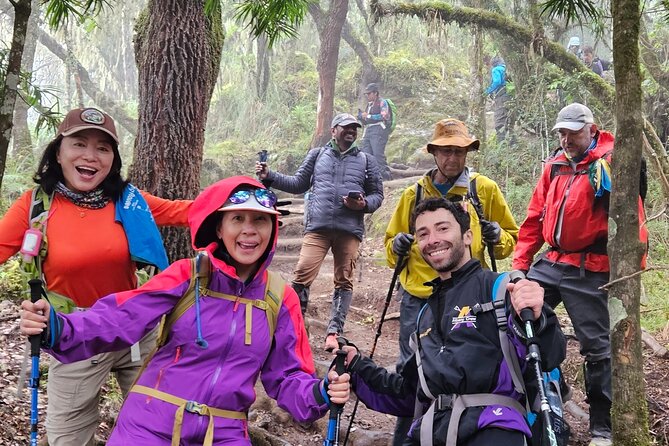
After breakfast, you drive by four-wheel-drive vehicle to Londrossi Gate. This is where the formal work begins. Your guides handle registration, and the mountain crew weighs duffle bags to keep each porter’s load within the 20-kilogram limit.
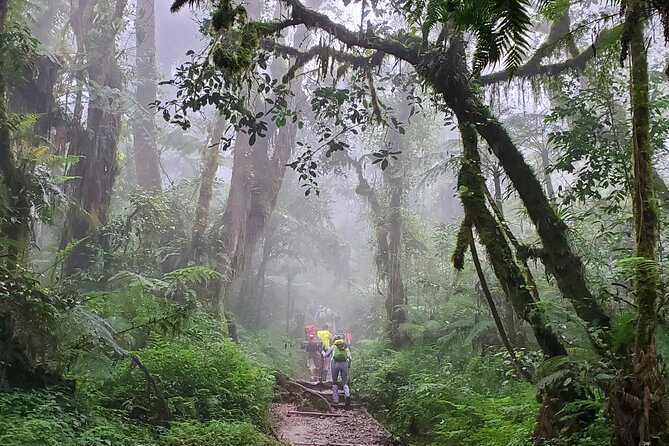
From the gate, the vehicle continues for about 11 kilometers along narrow dirt roads and through pine plantations. You begin walking at the Lemosho Glades, at roughly 1,981 meters. The day’s hike covers 7 kilometers and takes about four to five hours, finishing at 2,780 meters.
The setting is montane rain forest. This is a gentle introduction compared with what comes later, but the first day still tells you what the expedition will feel like: slow walking, a fixed camp routine, and a support crew carrying most of the shared equipment.
You sleep in a three-person expedition tent, normally with two clients sharing. A mountaineering mattress is provided, along with a mess tent and private portable flush toilet. Those details may sound small now, but they become very useful after several days without a hotel bathroom.
Day 2: The Shira Plateau at 3,511 meters
Day two is longer, with 12 kilometers and about seven hours of hiking. You climb from 2,780 to 3,511 meters, moving from montane forest into moorland.
The path follows narrow tracks that weave over ridges. Giant heather and erica appear first, followed by unusual giant lobelias and giant groundsel as you gain height. The scenery changes quickly, and the Shira Plateau opens up as you leave the forest behind.
This is a day for the Swahili rule pole pole, or slowly slowly. You may feel capable of walking faster, but that is exactly when restraint helps. Your guide’s job is not to get you to camp early. It is to help you arrive in good shape for the days ahead.
The 3511-meter camp is high enough to begin testing your altitude response. Headaches, poor sleep, low appetite, or nausea can occur at elevation. The package includes vital sign monitoring and a pulse oximeter, but you still need to tell the guide how you feel. Equipment helps the staff assess you. It cannot replace honest communication.
Day 3: Shark’s Tooth and the high desert
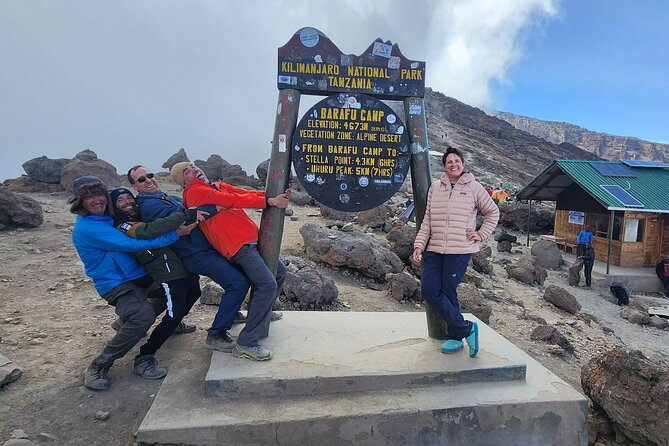
You walk 9 kilometers over five to six hours, rising from 3,511 to about 4,175 meters. The route heads north through heather and into an alpine desert zone.
The day’s landmark is Shark’s Tooth, a natural rock feature below the upper Kibo area. You pass hardy plants, small senecios, and a broad glacier-shaped bowl. Lava tube caves cut into the cliffs above, while views extend back toward the Shira Plateau.
This is one of the most scenic days because the mountain begins to look stark and otherworldly. Vegetation becomes sparse, and the wide views make the scale of Kilimanjaro easier to grasp.
The distance is moderate, but altitude changes the effort. A short climb at more than 4,000 meters can feel like a serious workout. Keep your pace steady, drink the purified water provided, and use rest stops to eat even if your appetite has faded.
Same base, a different kind of day out:
- Safari Serengeti And Ngorongoro
★ 5.0 · 288 reviews - Climbing Kilimanjaro – Machame Route
★ 5.0 · 170 reviews - Climbing Kilimanjaro through 7 days Machame Route
★ 5.0 · 151 reviews - Kilimanjaro climb, Lemosho Route (8-day)
★ 5.0 · 148 reviews
Day 4: Northern valleys and Pofu Camp
Day four is one of the more tiring walking days. You cover about 12 kilometers in seven to eight hours, climbing and descending repeatedly from 4,175 meters to roughly 4,020 meters.
You cross the northern face of Kibo through a series of valleys. Each ridge gives you a new view, then the trail drops again before rising toward the next one. This pattern can be more tiring than a steady climb because your legs never settle into one rhythm.
The vegetation changes from valley to valley, but the overall setting is semi-desert and remote. You finish at Pofu Campsite, a rocky and fairly barren camp on a high ridge.
This is where the Northern Circuit feels different from a standard route. You are not simply moving toward the summit on a direct line. You are circling the mountain, trading a few extra miles for quieter trails and more gradual altitude exposure.
Day 5: Completing the northern traverse
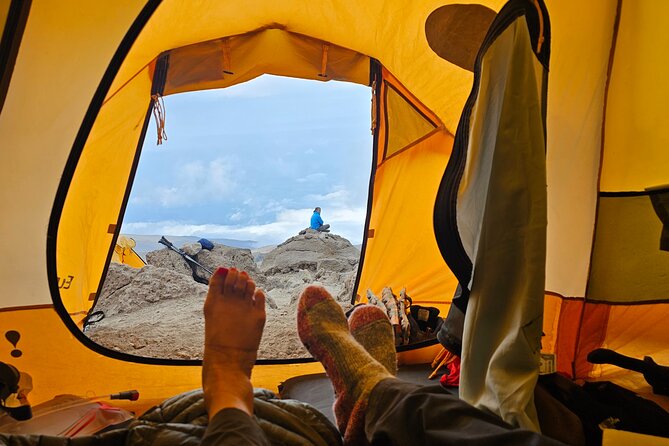
You walk 7 kilometers in about six hours, moving from approximately 4,020 to 3,960 meters. The small altitude drop does not mean an easy day. The route continues to rise and fall across rocky alpine desert and thin moorland.
Kibo and Mawenzi dominate the views. These two volcanic peaks give the walk a strong sense of place, and the open northern side lets you see the mountain from angles that differ from the western approach.
You arrive at Third Cave Camp after completing the Northern Circuit itself. This is a useful psychological point. The long detour is over, and the route now turns toward the summit preparation.
The shorter distance gives you time to rest, eat, and organize your clothing and headlamp for the summit push. Use it well. The next day includes a sharp climb, and the following day is the expedition’s hardest.
Day 6: The steep climb to School Hut
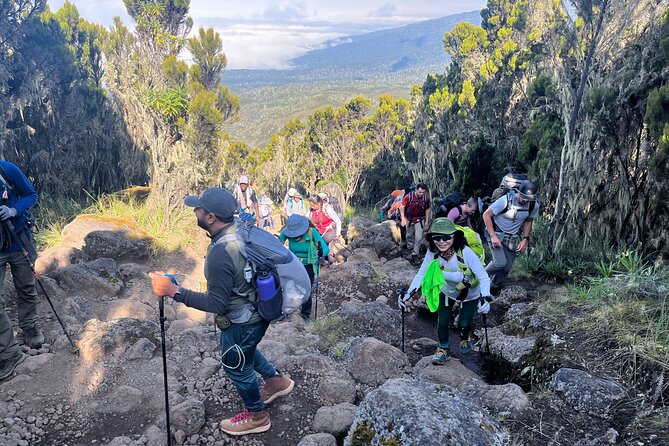
Day six covers only 6 kilometers, but the altitude gain is large. You climb from 3,960 to 4,790 meters, reaching School Hut after about five hours.
The 780-meter ascent is steep, and the thin air makes every slope feel longer. Stop often to breathe and take in the views. This is not wasted time. A controlled pace is part of the route plan.
School Hut is described as a mountain training facility for park rangers, set in an impressive position below Kibo Peak. The high camp puts you close to the summit route, but it also means sleeping at nearly 4,800 meters before the most difficult night.
You should expect a short sleep at best. The group leaves around midnight, so dinner, clothing, water, and personal gear need to be ready before you lie down. Your guide and crew handle the camp, food, and safety checks, but you still need to prepare your own summit layers and personal equipment.
Day 7: Gillman’s Point, Stella Point, and Uhuru Peak
Summit day is the test. You leave at about midnight after a warm drink and light snack, walking over stone scree toward Gillman’s Point and Stella Point.
The total day lasts 13 to 16 hours. You climb from 4,790 meters to the summit at 5,895 meters, then descend to about 3,100 meters. The total distance is approximately 19 kilometers.
The climb to Stella Point is slow and demanding. You will likely move in darkness for much of the ascent, with the pace set deliberately to conserve energy. At Stella Point, you stop for food and rest above the clouds.
The final two hours toward Uhuru Peak may be snow-covered. Each step can feel difficult at this altitude. The summit is the highest point in Africa, but reaching it is only part of the day. You still need to descend, and the descent is often hard on tired knees and feet.
The package includes emergency oxygen, a Gamow bag, comprehensive vital sign monitoring, a pulse oximeter, and a professional guide trained in wilderness first response or an equivalent qualification. Medical evacuation by AMREF Flying Doctors is also included, though the terms distinguish included cover from extra evacuation or medical costs. Ask for the precise limits before departure.
At the summit, wine and champagne are provided for the celebration. It is a cheerful touch after such a long night, but do not treat alcohol as a reward before you are safely descending. The summit team will also help mark the achievement with a certificate later at the park gate. Gold certificates are for Uhuru Peak, while green certificates are for Stella Point.
Day 8: A steep descent through Mweka forest
The final day covers 8 kilometers in roughly three to four hours. You descend from about 3,100 to 1,800 meters through montane rain forest.
The trail is steep in places and can become slippery when wet. It follows the crest of a broad ridge between two river valleys before reaching a road for the final 40-minute transfer to Mweka Park Gate.
At the gate, you stop for a picnic lunch and receive your summit certificate. Then you transfer to your hotel for the night. Your legs may feel worse on this day than expected. Descending uses different muscles, and a steep muddy trail is not a gentle finish.
The package includes two nights of bed-and-breakfast accommodation at either Ameg Lodge or Salinero Hotels. The exact placement of those nights should be confirmed when you book, along with the airport and hotel transfer details.
Camp life, food, and support on the mountain
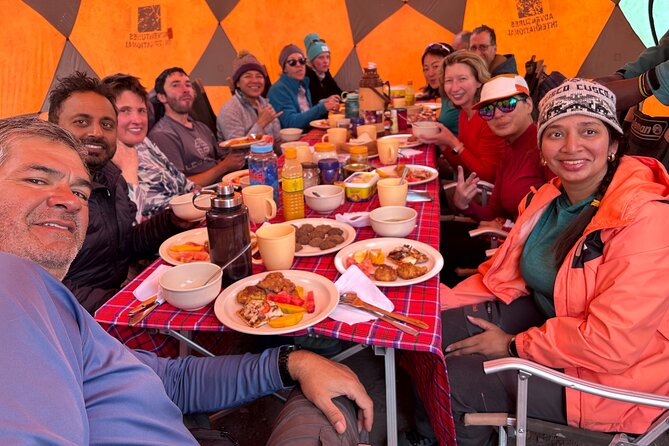
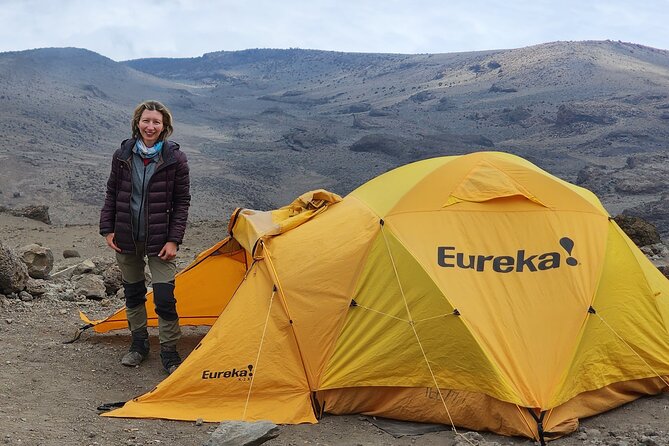
This is a full-service climb rather than a minimalist trek. Porters carry the main equipment, cooks prepare breakfast, lunch, and dinner, and the camp includes a walk-in mess tent with tables and chairs. A luxury chair with a backrest is also supplied, which becomes surprisingly valuable after a long walking day.
You receive hot washing water in the morning and evening, a hot towel at camp, and purified water while on the mountain. Large portions of fresh, healthy food are included. That matters because you need steady calories even when altitude reduces your appetite.
The equipment list includes expedition tents, mattresses, a shower and wash tent, a private portable flush toilet, a medical kit, radio communication, and a mobile phone. The package also states that porters, cooks, and guides receive salaries and that porter treatment is intended to be fair and ethical.
Personal trekking equipment is not included. You pay for your own clothing, boots, sleeping gear if needed, headlamp, bags, and other personal items. Staff gratuities are also separate, as are visas, immunizations, laundry, souvenirs, communication charges, and meals needed if illness forces you off the planned schedule.
The team names associated with the wider operator include Joseph, Kisali, Samuel, and Goodluck, but your assigned guide is not specified in the tour details. Ask for the guide’s name, qualifications, porter policy, and emergency plan before departure.
Who should book this climb?
I would choose this route if you want the best available acclimatization schedule and do not mind spending eight days on the mountain. It suits people who value quiet trails, private group arrangements, substantial camp support, and a slower approach over the shortest possible route.
It also suits families or friends who want to climb together, provided every member can manage long hiking days and the high-altitude environment. One past arrangement included parents, two 18-year-old sons, and friends, showing that the route can work for a mixed private group when everyone is prepared.
You should think twice if your priority is a low price, a short itinerary, or a simple summit weekend. The route costs $3,000, requires personal trekking equipment, and includes a summit day that can last most of a full day and night.
Free cancellation is available if you cancel at least 24 hours before the start time. Changes made inside that period are not accepted, and poor weather may lead to a new date or a full refund. The activity is marked suitable for most participants, but that does not remove the need for proper medical and fitness planning.
Should you book the Northern Circuit?
Book it if you want a private, well-supported Kilimanjaro climb with more acclimatization time and fewer crowds on the northern slopes. The safety equipment, meals, porters, hotel nights, transfers, and camp services give the $3,000 price real substance.
Do not book it expecting an easy route. The long summit day, repeated climbs and descents, high camps, and steep final forest trail demand patience and preparation. For the right climber, the Northern Circuit offers a slower, quieter way to earn Uhuru Peak, with practical support from the first gate registration to the certificate at Mweka.
FAQ
How long is the Kilimanjaro Northern Circuit tour?
The tour lasts eight days, including the approach, Northern Circuit traverse, summit attempt, descent, and hotel transfer after leaving the mountain.
What is the highest point reached?
The summit day reaches Uhuru Peak at 5,895 meters. You approach the summit via Gillman’s Point and Stella Point.
Is this a private tour?
Yes. Only your own group takes part in the activity.
What accommodation is included?
The package includes two nights of bed-and-breakfast accommodation at either Ameg Lodge or Salinero Hotels. On the mountain, you sleep in three-person expedition tents, normally with two clients per tent.
Are meals included?
Yes. The package includes eight breakfasts, eight lunches, and seven dinners. Large portions of fresh, nutritious food are prepared on the mountain.
What does the $3,000 price include?
It includes park entrance, camping or hut and rescue fees, airport transfers, hotel accommodation, guides, cooks, porters, tents, mattresses, meals, purified water, medical equipment, emergency oxygen, a Gamow bag, and AMREF Flying Doctors medical evacuation cover. Personal trekking equipment, visas, gratuities, laundry, souvenirs, and some additional medical or evacuation costs are not included.
Just added in Moshi
- Wildlife Extravaganza: Manyara, Tarangire & Ngorongoro in 3 Days★ 5.0 · 3 reviews
- West Kilimanjaro cycling Adventures★ 4.5 · 8 reviews
- machame route★ 5.0 · 16 reviews
- Mt Kilimanjaro 6 days Marangu route hike★ 5.0 · 3 reviews
- Kilimanjaro Climb • Machame Route ~ 10 Day★ 5.0 · 6 reviews
- Kilimanjaro Climbing Umbwe Route★ 5.0 · 3 reviews
- 3 Days Private E-Bike Tour in West Kilimanjaro★ 5.0 · 3 reviews
- Private Cycle to Kilimanjaro Bike Park Safari★ 5.0 · 6 reviews
Kilimanjaro Treks, compared.



8-Day Small-group Lemosho Kilimanjaro Summit Trekking
Read our review →

5 Days Best of Tanzania Luxury Safari Northern Circuit
Read our review →

Climbing Kilimanjaro through 7 days Machame Route
Read our review →
7-Day Machame Kilimanjaro Summit Tour from Arusha
Read our review →Browse the lists this tour appears in