
Reviewed · KILIMANJARO TREKS
Top 6 Days Mt. Kilimanjaro Bike trek Tour by Marangu-Kilema Route
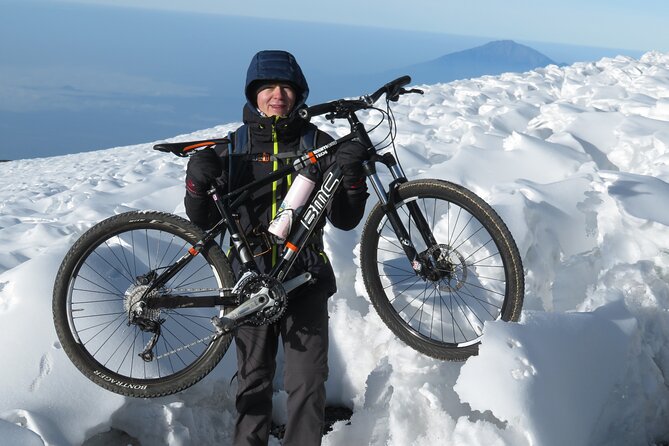
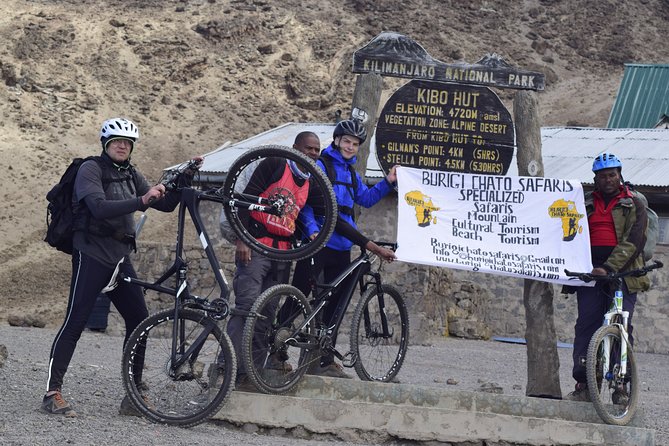
Kilimanjaro is usually pictured as a walking challenge, but the Kilema Route lets strong mountain bikers take a bike high onto Africa’s tallest peak. You ride from the rainforest toward Horombo, cross the stark alpine desert, carry or push your bike over rough sections, and attempt Uhuru Peak during a cold, early-morning summit climb.
I like the changing mountain zones and the practical support: transfers, meals, porters, huts, and a guide are arranged for you. I also like that the route includes a genuine summit attempt, not just a short ride on the lower slopes. The main caution is simple: this is not a standard cycling holiday. Thin air, steep scree, freezing conditions, and broken trail mean you will often hike beside your bike.
Key things to know before you book
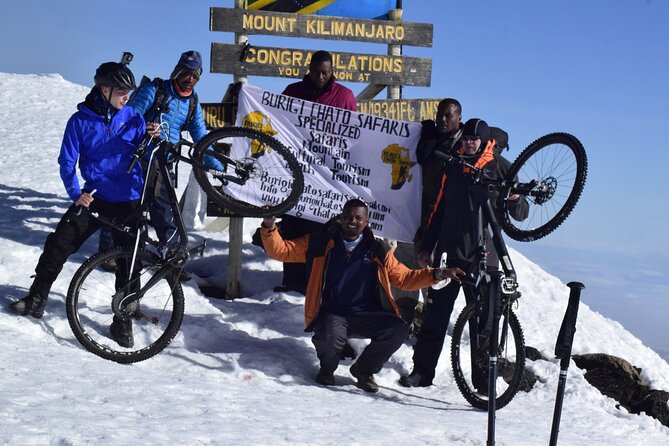
- The Kilema Route is Kilimanjaro’s bike-accessible summit route, but some upper sections are too rocky to ride.
- Horombo Hut is reached on the first day, after a 16-kilometer climb from the Kilema Gate.
- The summit attempt starts around 4 a.m., with cycling possible only on selected sections near Uhuru Peak.
- You cross several distinct environments, including rainforest, alpine desert, ice fields, and glacier country.
- Porters, meals, transfers, and crew wages are included, but bike rental and personal mountain gear are not.
- The $3,668 price is substantial, though it covers a private transport arrangement and much of the difficult mountain logistics.
What this six-day Kilimanjaro bike trek really involves
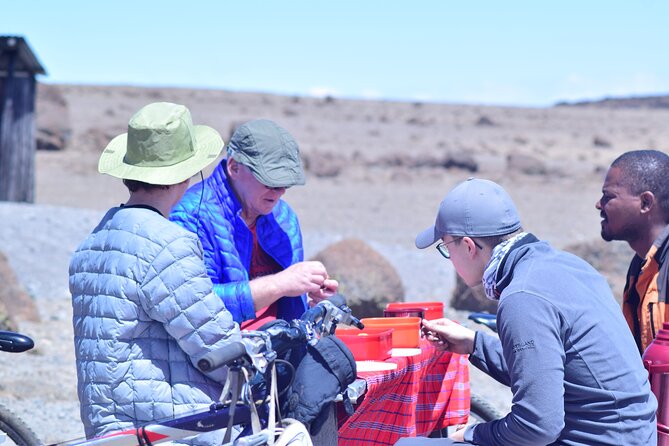
The name can make this sound like six days of continuous riding. It is better understood as a high-altitude mountain expedition with a bicycle. You will ride where the trail allows it, push when rocks and erosion take over, and walk during the hardest summit sections.
The route begins near Moshi and uses the Marangu Gate for registration before continuing by vehicle to the Kilema Gate. From there, the ride starts at about 1,950 meters and climbs to Horombo Hut at roughly 3,705 meters on day one. That is a serious gain in height, even before the higher and colder days arrive.
Your mountain-bike guide rides with you, and porters carry equipment and help move bikes on sections that are unsafe or impractical to ride. The support matters because you need to conserve strength for altitude, not spend every reserve wrestling a bicycle over loose stone.
The experience is aimed at people with good fitness, real mountain-biking ability, and comfort with rough surfaces. A moderate fitness level is listed as the minimum, but the actual demands are higher than that wording suggests. You should be ready for long uphill hours, poor oxygen, cold, early starts, and a summit night that combines hiking and bike handling.
Other routes up the mountain from Moshi:
- Kilimanjaro climb by Lemosho Route (7-day)
★ 5.0 · 651 reviews - Kilimanjaro climb, Machame Route (7-day)
★ 5.0 · 262 reviews - Kilimanjaro Climbing Lemosho Route 8 Days.
★ 5.0 · 186 reviews
Day 1: From Moshi to Kilema Gate and Horombo Hut
The first transfer takes about 45 minutes from Moshi to the Marangu Gate. You register at the park office, then continue by vehicle to the Kilema Gate, where you check your daypack and bicycle.
Keep water, lunch, extra clothing, and anything you may need during the day in the pack you carry yourself. This is not the moment to discover that your warm layer is buried in a duffel bag being carried ahead.
The first cycling section covers about 16 kilometers from Kilema Gate to Horombo Hut. The route rises through forest-like vegetation and into higher mountain country. Strong riders may pedal much of it, depending on trail conditions, but the surface can be rough and the climb is long.
Horombo is an important first night because it gives you a chance to rest at altitude while still having some energy to move around. One useful piece of advice from the trip details is to walk around a little near the hut rather than staying completely still. Gentle movement can help you get used to the height, but do not turn the evening into another workout.
Day 2: Alpine desert riding toward Mawenzi Hut
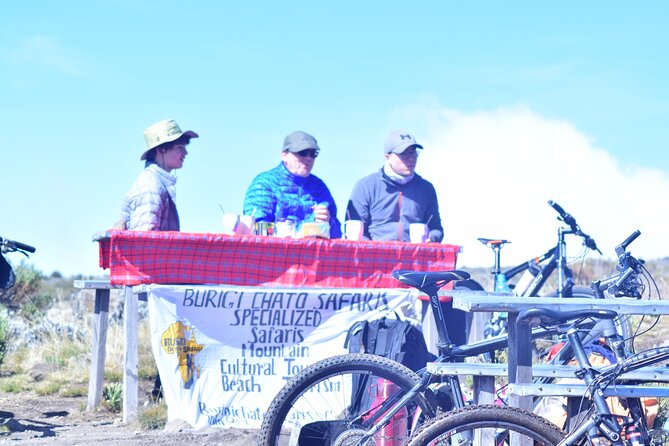
Day two is a high-altitude acclimatization day based around Horombo Hut. After breakfast, you ride through the alpine desert toward Mawenzi Hut and return to Horombo. The stated cycling distance is about 10 kilometers, and around 90 percent of the day is described as riding.
This is one of the more appealing days for mountain bikers because the setting changes sharply from the greener lower slopes. Plants become sparse, the ground is more exposed, and the volcanic peaks feel closer. Small stones and rough trail sections add technical interest, but the altitude keeps the pace controlled.
Do not judge the day by distance alone. At this height, a short ride can feel like a long one. The return to Horombo is useful for acclimatization, but it also means you spend many hours at altitude. Eat properly, drink often, and treat the day as preparation for the more punishing climb to Kibo.
Day 3: Across the Saddle toward Kibo Hut
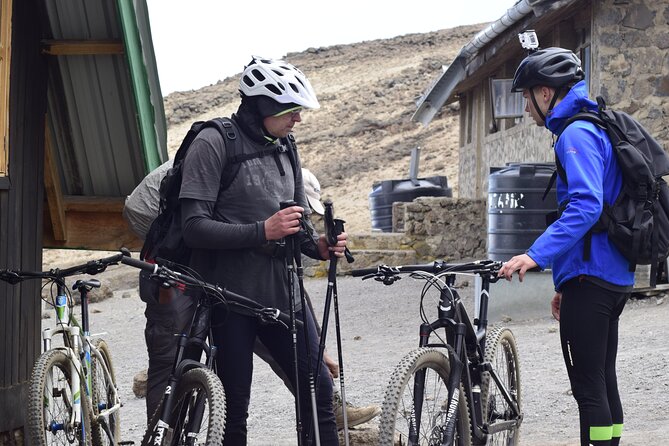
After an early breakfast, you head higher into the alpine desert. The first three kilometers are described as very rocky, eroded, and difficult to cycle. Expect to push or carry the bike for stretches rather than forcing every pedal stroke.
The trail improves after those first three kilometers. The Saddle, the broad area between Mawenzi and Kibo, is relatively flat by comparison, so cycling becomes easier. That flatter ground can feel like a gift after the rough opening section.
The final seven kilometers to Kibo Hut are the real test. The trail may be more rideable, but altitude, cold, and low oxygen make the distance demanding. The last kilometer is especially strenuous. Your guide will remind you to slow down and drink, and you should take that advice seriously even if you normally ride hard and fast.
Kibo Hut is around 4,700 meters above sea level. There is little vegetation here, and the feeling is stark and exposed. The upper mountain is not a place for casual wandering. Keep your clothing dry, organize your equipment, and conserve energy for the summit attempt.
Same base, a different kind of day out:
- Safari Serengeti And Ngorongoro
★ 5.0 · 288 reviews - Climbing Kilimanjaro – Machame Route
★ 5.0 · 170 reviews - Climbing Kilimanjaro through 7 days Machame Route
★ 5.0 · 151 reviews - Kilimanjaro climb, Lemosho Route (8-day)
★ 5.0 · 148 reviews
Day 4: Rest, equipment checks, and summit preparation
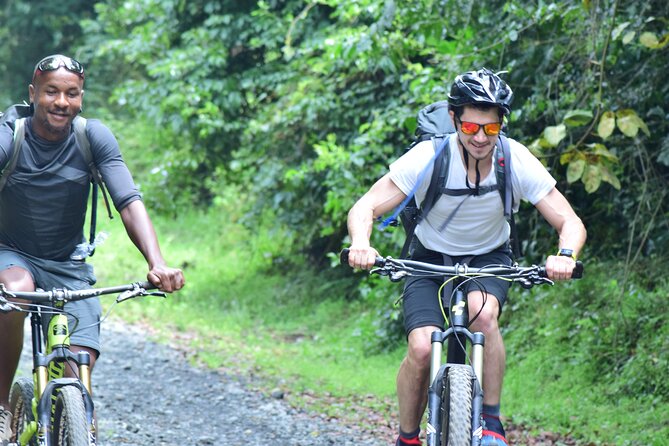
The schedule for day four is less about gaining height and more about preparing for the summit night. You make sure your duffel is packed, return toward the Kibo area as needed, eat lunch, and aim to rest.
Around 4 p.m., you may partially hike up the summit path to get your bearings. This can help you understand the route before setting out in darkness, but it should remain a gentle orientation walk, not a serious training session. The summit is still about 1,195 meters higher.
Use this afternoon to check every small item. Thermal clothing, headlamp, spare batteries, camera batteries, water, gloves, and food should be easy to reach. Cold can affect batteries and drinking tubes, and one account connected with this experience describes water freezing during the summit night. Plan for that possibility by keeping essential items protected from the cold.
The day may feel frustrating if you are eager to ride, but rest is one of the most valuable parts of a high-altitude climb. You need your legs and concentration for the early start.
Day 5: Uhuru Peak, the bike, and the long return to Horombo
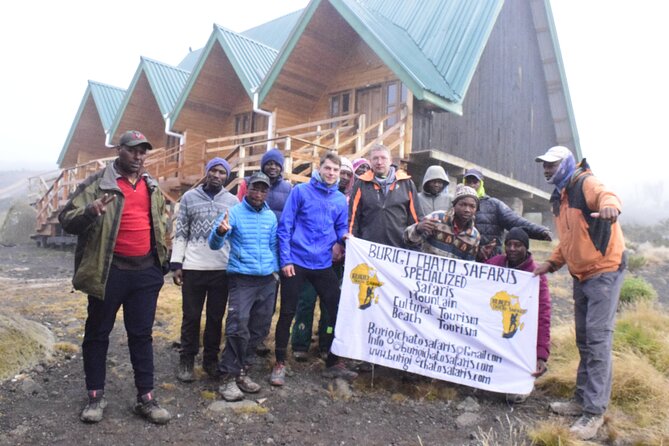
The summit day begins around 4 a.m. You climb a zigzag trail over a long scree slope. After roughly two hours, you reach Hans Meyer’s Cave, where the gradient becomes steeper. The climb continues for about three more hours toward Gilman’s Point.
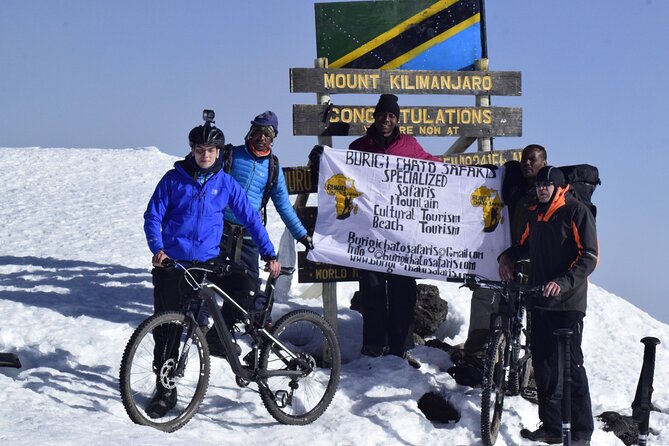
This section is primarily a hike. The surface is loose and steep, and the altitude makes every step slower. At Gilman’s Point, porters bring your bike so you can ride selected sections toward Uhuru Peak. That is a remarkable part of the experience, but it is not a smooth downhill run. The trail remains high, cold, and demanding.
You spend a short time at Uhuru Peak for photographs before riding down toward Stella Point. Conditions at the summit can change quickly, and your time there should be guided by how you feel, not by the desire to stay for a perfect photograph.
After lunch, the route continues down toward Horombo. The description gives the cycling share from Kibo to Uhuru as about 15 to 20 percent, with alpine desert and ice-cap scenery on the higher sections. From Kibo to Horombo, you pass through more alpine desert and ice-field country. The descent may feel easier than the climb, but tired legs and rough ground create their own risks.
The summit day is listed at about eight hours, though the exact timing can vary with pace, trail conditions, and altitude. You should expect a very long and tiring day. The reward is not simply reaching the highest point. It is also the strange, memorable sight of riding a bicycle on the upper slopes of Kilimanjaro.
Day 6: The final ride through forest to Moshi
After breakfast, you make the final descent to the Kilema Gate. The route crosses alpine terrain before returning through rainforest, giving you one last change in scenery.
This should be the most enjoyable riding day physically because you are going downhill and losing altitude. Even so, stay alert. Fatigue, wet trail, rocks, and mechanical problems can make a descent harder than it looks.
At Kilema Gate, a vehicle takes you to the Marangu Gate for check-out, then back to your hotel in Moshi. The listed riding time is about two hours, but transfers and park procedures add to the day.
What the $3,668 price includes
At $3,668 per person, this is a major expense. The value comes from the amount of coordination involved rather than from the riding distance alone.
The package includes private transportation, gate transfers, airport pickup and drop-off, crew wages, fees and taxes, meals, and porter support. Dinner is listed for six nights, lunch for six days, and breakfast for five days. Hotel accommodation before and after the mountain trip can be arranged through the operator or booked directly by you.
The price also saves you from organizing vehicles, park access, food, mountain crew, and luggage movement separately. For a first Kilimanjaro attempt, that support can be worth a great deal.
You should budget extra for the bicycle itself because bike hire is not included. Personal mountain clothing and equipment are also extra, as are flights, visas, and tips for the crew. Ask for a clear equipment and bike-rental quote before paying, especially if you are not bringing your own suitable mountain bike.
The package is described as a private transport arrangement, but the activity can accommodate up to 200 people. That maximum is large, so ask how your own riding group is organized and how many people will be with your guide on the mountain.
The guide and crew make a practical difference
A capable guide is essential here. You need someone who knows when to encourage you, when to slow the pace, and when to insist that you walk rather than ride a dangerous section.
A guide named Gabriel is associated with the Kilimanjaro bike experience and is specifically linked with the enjoyable day-one ride to Horombo. The crew also includes porters, who help carry equipment and move bikes over the upper trail.
The crew support appears to be one of the strongest parts of the experience. Porters prepare camp or hut arrangements, carry loads, and assist when altitude sickness or exhaustion becomes a concern. One account describes first-aid help being provided when altitude problems appeared. That does not make the mountain safe, but it shows why experienced support matters.
There is one practical warning: one account describes a guide’s bicycle breaking and a delay while another bike was found. Ask what repair tools, spare parts, and replacement-bike plans are carried. On a remote mountain route, mechanical backup is not a luxury.
Who should book this, and who should choose a normal trek?
You should consider this trip if you already ride mountain bikes on rough, uneven ground and enjoy the idea of mixing cycling with serious hiking. You also need patience. The best rider is not necessarily the fastest one, but the person who can keep a steady pace and manage energy over six days.
This is a good fit for someone who wants a more unusual Kilimanjaro challenge than a standard walking route. It also suits cyclists who enjoy changing surfaces, remote settings, and the technical problem of handling a bike at altitude.
You should think twice if you want continuous downhill riding, comfortable camping, or a relaxed sightseeing schedule. The upper trail is not a bike park. You will hike significant sections, sleep in mountain huts, face freezing temperatures, and deal with limited oxygen.
Non-summit versions are available, so you can ask about a shorter or lower-altitude option if reaching Uhuru Peak is not your main goal. That may be a better choice if you want the mountain-bike experience without committing to summit-night conditions.
Practical details before you commit
Pickup is offered, and the activity starts at 9 a.m. Confirmation is provided at booking. The tour requires good weather, and a cancellation caused by poor conditions results in a different date or a full refund.
You can cancel for a full refund up to 24 hours before the start time. Changes or cancellations made inside that period are not accepted for a refund.
The tour is near public transportation, though the included private transfers are more useful for the park gates and mountain logistics. You should also confirm whether your pre- and post-trek hotel nights are included in your chosen rate, since the accommodation wording allows you to book those nights directly.
Should you book the Kilimanjaro bike trek?
Book it if the unusual combination of mountain biking, high-altitude hiking, and a summit attempt is exactly what you want. The Kilema Route gives you access to forest, alpine desert, ice fields, and Uhuru Peak, while porters, meals, vehicles, and crew support take much of the planning burden away.
Do not book it simply because you like ordinary cycling. Bring or rent a proper mountain bike, prepare for long walking sections, and take the altitude seriously. At $3,668, the trip deserves careful questions about bike hire, mechanical support, group size, and equipment before payment.
For a strong cyclist who wants to reach Africa’s highest point in an unconventional way, this is a memorable and demanding choice. For a casual rider, a non-summit version or a standard walking route may be the wiser call.
FAQ
How long is the Kilimanjaro bike trek?
The experience lasts approximately six days, including the approach to Horombo, the climb toward Kibo, the summit attempt, and the descent to Kilema Gate.
Which route is used?
The trip uses the Marangu and Kilema route system. You register at Marangu Gate, then continue to Kilema Gate, the starting point for the bike ascent.
Is bicycle rental included?
No. Trekking mountain-bike hire is not included in the listed price. You must arrange rental separately or bring a suitable bike.
Are meals and porters included?
Yes. The package includes porter support, crew wages, six dinners, six lunches, and five breakfasts.
Is personal mountain gear included?
No. Personal mountain trekking gear is excluded. You must arrange the clothing and equipment needed for cold, high-altitude conditions.
When does the summit attempt begin?
The summit attempt starts at about 4 a.m. on day five. You hike toward Gilman’s Point, then take your bike for selected sections toward Uhuru Peak.
What happens if poor weather cancels the trip?
If poor weather causes cancellation, you are offered another date or a full refund. For your own cancellation, a full refund is available if you cancel at least 24 hours before the experience begins.
More Hiking & Trekking in Moshi
- Private Kilimanjaro Hike 7 Day Lemosho Route
★ 5.0 · 60 reviews - Best Kilimanjaro hiking day trip tour with Kilinge Adventures
★ 4.5 · 54 reviews - #1. Best Kilimanjaro Day hike Tour-Machame Route-ISMANI
★ 4.2 · 47 reviews - Best Kilimanjaro Adventure 7 days Machame route Trekking
★ 5.0 · 42 reviews
Just added in Moshi
- Wildlife Extravaganza: Manyara, Tarangire & Ngorongoro in 3 Days★ 5.0 · 3 reviews
- West Kilimanjaro cycling Adventures★ 4.5 · 8 reviews
- machame route★ 5.0 · 16 reviews
- Mt Kilimanjaro 6 days Marangu route hike★ 5.0 · 3 reviews
- Kilimanjaro Climb • Machame Route ~ 10 Day★ 5.0 · 6 reviews
- Kilimanjaro Climbing Umbwe Route★ 5.0 · 3 reviews
- 3 Days Private E-Bike Tour in West Kilimanjaro★ 5.0 · 3 reviews
- Private Cycle to Kilimanjaro Bike Park Safari★ 5.0 · 6 reviews
Kilimanjaro Treks, compared.



8-Day Small-group Lemosho Kilimanjaro Summit Trekking
Read our review →

5 Days Best of Tanzania Luxury Safari Northern Circuit
Read our review →

Climbing Kilimanjaro through 7 days Machame Route
Read our review →
7-Day Machame Kilimanjaro Summit Tour from Arusha
Read our review →Browse the lists this tour appears in