
Reviewed · KILIMANJARO TREKS
5 Days Marangu Route Kilimanjaro Climbing
Kilimanjaro’s Marangu Route gives you something no other main route does: a bed in a mountain hut every night. You still face Africa’s highest summit, thin air, cold, loose volcanic scree, and a summit day that can last 11 to 15 hours, but you do not sleep in a tent. That makes this route feel more approachable, not easy.
I like the hut setup, with bunks, sponge mattresses, pillows, and solar lights. I also like the steady change in scenery, from coffee and banana farms near Marangu to rainforest, moorland, high desert, and the crater rim. Guide Gasto is associated with the Mountain Warriors team and is described as having climbed Kilimanjaro about 250 times. Ask in advance who will lead your group.
The main drawback is the five-day schedule. You reach high altitude quickly, with no dedicated acclimatization day between Horombo and Kibo. The route can be done in six days, adding rest at Horombo or a climb toward Mawenzi, and that extra day is worth serious thought.
Key points to know before booking
- Huts replace tents: You sleep in communal bunk rooms with mattresses, pillows, and solar lighting at Mandara, Horombo, and Kibo.
- The summit day is severe: You start around 1 a.m., reach Gillman’s Point near sunrise, and may continue to Uhuru Peak.
- The scenery changes fast: Expect forest, giant heather, moorland, volcanic scree, and the high Saddle between Mawenzi and Kibo.
- The package covers major costs: Park fees, rescue fees, hut nights, mountain meals, guides, transfers, and purified drinking water are included.
- Five days favors speed over acclimatization: The six-day option adds time at altitude and may improve your comfort and summit prospects.
- The tour is private: Only your group takes part, with pickup offered and a 7:30 a.m. start.
What the $1,730 price really covers
At $1,730 per person, this is not a simple guided hike. The price includes mountain hut accommodation, professional mountain guides, national park fees, rescue fees, all meals on the mountain, airport transfers, purified drinking water, and a mess setup with tables and chairs.
That list matters on Kilimanjaro. Park and rescue charges alone are not minor extras, and the mountain crew handles food, camp organization, route support, and the daily move between huts. You are paying for a supported climb rather than arranging each part separately.
The included meals are another useful part of the value. The supplied details describe breakfast, lunch, and dinner throughout the five days, with food prepared and served on the mountain. Personal snacks are not listed, so I would ask what you should bring for the summit night and whether special diets can be handled.
You still need to budget for a Tanzania visa, tips, and personal climbing gear. The gear exclusion is important. The available details do not specify rental options, so ask about clothing, boots, trekking poles, sleeping bags, and other equipment before you pay. Do not assume the operator supplies your full mountain kit.
The tour offers free cancellation up to 24 hours before the local start time. Inside that window, the amount paid is not refunded, and late changes are not accepted.
Other routes up the mountain from Arusha:
- 8-Day Small-group Lemosho Kilimanjaro Summit Trekking
★ 5.0 · 186 reviews - 5 Days Best of Tanzania Luxury Safari Northern Circuit
★ 5.0 · 174 reviews - 7-Day Machame Kilimanjaro Summit Tour from Arusha
★ 5.0 · 125 reviews
Day 1: Marangu Gate to Mandara Hut
Pickup begins at 7:30 a.m., with transport from Arusha or Moshi to the Kilimanjaro National Park gate near Marangu. The gate sits at about 1,830 meters, beside a village known for small coffee and banana plantations.
The first walking day leads into attractive forest. It is a gentle introduction in scenery, but not necessarily a free pass for your legs. You gain roughly 870 meters before reaching Mandara Hut at 2,700 meters, with three to five hours of walking listed for the route.
The forest is one of the pleasures of this opening stage. Birdlife is common around the huts, and monkeys may appear. The route feels shaded and green, a sharp contrast to the bare volcanic ground higher up.
If you arrive with energy, Maundi Crater makes a good afternoon outing. If the climb has taken more from you than expected, resting near Mandara is the smarter choice. The first day is a useful test of your pace. Walk slowly, drink regularly, and avoid treating the easy-looking forest as a race.
Mandara’s huts are communal. You sleep on a bunk with a sponge mattress and pillow, and solar lighting is provided. This is more basic than a hotel, but it is a real advantage for anyone who dislikes tent camping.
Day 2: Moorland views on the way to Horombo
Day two starts with a steeper section through forest before the path reaches open moorland. At about 3,720 meters, Horombo Hut brings a noticeable change in air, plant life, and views.
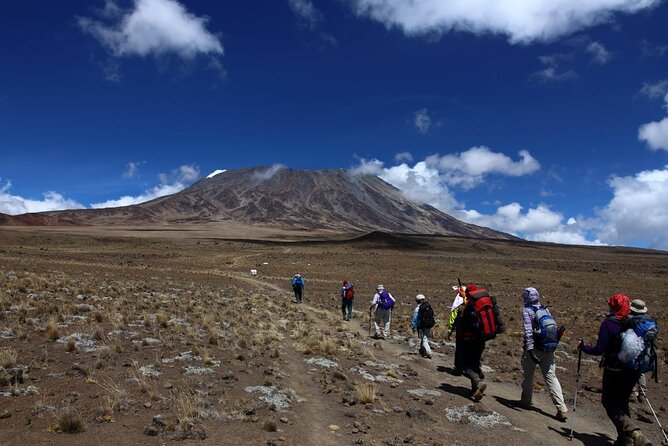
The route takes four to six hours from Mandara. You pass giant heather and occasional groundsel, with views toward Kibo and Mawenzi when the weather is clear. The peaks give you a better sense of the mountain’s scale, while the open ground lets you see how far you have climbed.
Horombo is one of the most memorable camps on the route. Sunrises and sunsets can be striking, and the hut sits close enough to Kibo for the mountain to feel immediate. The description of being above the clouds is not just marketing language here. The elevation creates that impression when conditions cooperate.
This is also where the five-day schedule begins to feel demanding. You are sleeping at 3,720 meters, then moving to Kibo the next day. If you choose the six-day version, Horombo is the logical place to rest or make an acclimatization walk toward the small peak of Mawenzi.
That added day costs time, but it gives your body more room to adjust. I would favor six days for anyone concerned about altitude, especially if you have limited experience with high mountain walking.
Day 3: The Saddle and Kibo Hut at 4,700 meters
The walk from Horombo to Kibo is gradual rather than sharply steep, but altitude changes the effort. The route crosses the Saddle, a broad high zone between Mawenzi and Kibo. Plants thin out, the ground becomes volcanic scree, and the sense of wilderness increases.
You usually reach Kibo Hut around midday after four to five hours. At roughly 4,700 meters, this is the highest sleeping point on the trip. The remainder of the day is set aside for eating, resting, and preparing for the summit attempt.
Do not underestimate this afternoon. It may seem wasteful to lie down when you have reached such a dramatic place, but rest is the job. Your group starts the summit climb around 1 a.m., so you need to protect your energy.
Kibo is a basic communal hut, not a comfortable base lodge. The bed is valuable, but sleep at this altitude may be broken. Keep your evening simple, organize your clothing and gear before resting, and follow your guide’s pace and instructions.
Same base, a different kind of day out:
- Serengeti Balloon Safari and authentic bush breakfast
★ 5.0 · 2,480 reviews - Balloon Safari & Bush Breakfast in Serengeti – Miracle Experience
★ 5.0 · 1,646 reviews - Tanzania Classic – 7 Days
★ 5.0 · 1,151 reviews - 4 Days Group Camping Safari
★ 5.0 · 1,101 reviews
Day 4: Gillman’s Point, Uhuru Peak, and the long return
Summit day is the hard center of the trip. The climb begins by torchlight at about 1 a.m., aiming to reach Gillman’s Point at sunrise.
The first part rises over loose volcanic scree. The route includes graded zigzags, but the combination of steep ground, darkness, cold, and altitude makes it slow work. The expected time to Gillman’s Point is about five or six hours.
At 5,685 meters, Gillman’s Point sits on the crater rim. You stop there to rest and watch the sunrise. Reaching this point is a major achievement, but it is not the highest point on Kilimanjaro.
If you still have strength, you can continue along the crater rim to Uhuru Peak at 5,896 meters. The round trip from Gillman’s Point takes about three hours and passes near summit glaciers. The extra section is exposed to fatigue, so your guide will be important in judging how you are doing.
The supplied schedule lists 11 to 15 hours of walking for the summit day and return to Horombo. That is the figure to take seriously when deciding if this trip suits you. You descend from Kibo after the summit effort and spend the night at Horombo, making the return far more manageable than trying to reach the park gate the same day.
The descent may feel surprisingly quick compared with the climb, but your legs will be tired. This is not the evening for a celebration that runs late. Eat, drink, and rest.
Day 5: From Horombo back through the forest
The final day retraces the route through the moorland to Mandara, then continues through the forest to the park gate. The walking time is listed as five to six hours.
This return gives you a second look at parts of the mountain that felt different on the way up. The bare high-altitude zones give way to heather, then to thick forest. After the summit, the greenery can feel almost startling.
From the gate, transport returns you to Moshi or Arusha. Airport transfers are included in the package, but the supplied details do not set out exact transfer timing. If you have a flight the same day, confirm the plan carefully and allow room for delays and your condition after the descent.
Hut life, meals, and support on the mountain
The Marangu Route’s huts are its defining practical feature. You sleep in communal rooms rather than tents, with bunk beds, sponge mattresses, pillows, and solar lights. That reduces some of the discomfort of a camping climb, though it does not provide privacy.
You also get a quality mess tent with tables and chairs. Since meals are included, you can spend more attention on pacing and recovery instead of managing cooking equipment. Several accounts connected with the operator highlight hot, freshly prepared food, so meal service is one area to ask about if it matters to you.
Mountain Warriors Tours and Safaris provides professional mountain guides, and the named guide Gasto has been described as having extensive experience, including around 250 Kilimanjaro climbs. The team has also been credited with helping carry heavy luggage, preparing meals, and supporting climbers during the summit effort.
That support is valuable, but it does not remove the need for your own preparation. The operator cannot make the altitude disappear. A moderate level of physical fitness is required, and the four to six hours on ordinary walking days can turn into a very long summit day.
Who should choose the five-day route
I would consider this route for someone who wants Kilimanjaro with hut accommodation and a clear, direct itinerary. It suits a private group that values practical support, included meals, and a route that does not require carrying a tent.
It may also work well for people who prefer a familiar room-like shelter at night. The huts are communal and basic, but they are still a different experience from sleeping outdoors in a tent.
The five-day version is less suitable if you want the gentlest altitude plan. The six-day option gives you an extra day at Horombo, either for rest or for a walk toward Mawenzi. That extra time is the most useful upgrade available in the supplied options.
You should also think carefully about the summit schedule. The 1 a.m. start and 11 to 15 hours of walking demand patience, strength, and a willingness to turn around if you are not well. Reaching Uhuru Peak is not the only measure of a successful climb. Safety comes first.
Should you book this Kilimanjaro climb?
Book this experience if hut accommodation, private-group service, included mountain meals, and a lower price than many luxury-style climbs matter to you. The $1,730 package covers the costly basics, and the support team appears to be a major part of the experience.
Before booking, ask for three clear answers: can you choose the six-day version, who exactly will guide your group, and what personal gear can be rented or arranged? If you want the best chance to adjust to altitude, I would favor six days over five.
The five-day Marangu Route is not an easy stroll. It is simply the shortest and most straightforward hut-based route described here. If you accept the demanding summit night and prepare properly, it offers a practical way to experience Kilimanjaro’s changing scenery without camping.
FAQ
Where does the Kilimanjaro climb start?
The climb starts with pickup at 7:30 a.m. from Arusha or Moshi, followed by a drive to the Kilimanjaro National Park gate near Marangu.
How long is the Marangu Route experience?
The experience lasts approximately five days. A six-day version is also possible for better acclimatization.
Where do I sleep during the climb?
You sleep in communal mountain huts at the campsites. The huts have bunk beds, sponge mattresses, pillows, and solar lights.
Is camping equipment provided?
No tent camping is described for this route because accommodation is in huts. Personal climbing gear is not included.
Is food included?
Yes. Breakfast, lunch, and dinner are included while you are on the mountain.
Is drinking water included?
Yes. Clean, purified drinking water is included.
Are park and rescue fees included?
Yes. All park fees and rescue fees are included in the package.
How difficult is the summit day?
The summit climb begins at about 1 a.m. The walk from Kibo Hut to Gillman’s Point takes about five or six hours, and the full summit day and return to Horombo is listed as 11 to 15 hours.
Can I continue from Gillman’s Point to Uhuru Peak?
Yes, if you are still feeling strong. The round trip from Gillman’s Point to Uhuru Peak takes about three hours.
Is this a private tour?
Yes. Only your group takes part in the activity.
Just added in Arusha
- 4 Days Private Midrange Lodge Safari to Serengeti & Ngorongoro★ 5.0 · 4 reviews
- Extraordinary Hot air Bolloon ride in Serengeti | BURIGI CHATO SAFARIS CO L.T.D★ 5.0 · 6 reviews
- 8 Days Serengeti Migration safari★ 5.0 · 11 reviews
- 3 days leopard safaris★ 5.0 · 4 reviews
- tarangire, ngorongoro & lake manyara park 3 days private tour★ 5.0 · 11 reviews
- Mt. Kilimanjaro: Shira plateau to Cathedral point 3872m Day hike★ 5.0 · 7 reviews
- serengeti, ngorongoro & tarangire 4 days private tour★ 5.0 · 18 reviews
- tarangire & ngorongoro 2 days tour★ 5.0 · 14 reviews
Kilimanjaro Treks, compared.



8-Day Small-group Lemosho Kilimanjaro Summit Trekking
Read our review →

5 Days Best of Tanzania Luxury Safari Northern Circuit
Read our review →

Climbing Kilimanjaro through 7 days Machame Route
Read our review →
7-Day Machame Kilimanjaro Summit Tour from Arusha
Read our review →Browse the lists this tour appears in