
Reviewed · KILIMANJARO TREKS
7-Day Mt. Kilimanjaro Hiking: Machame Route
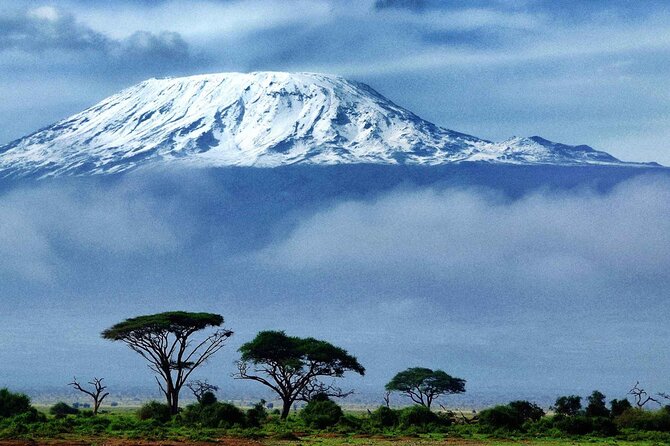
The big draw here is the Machame Route’s changing scenery. You start in wet rainforest, cross open moorland and stark alpine desert, then climb through cold volcanic scree toward Uhuru Peak at 5,895 meters. It is a serious mountain trek, not a casual week in the hills.
I like the route’s built-in acclimatization day at Lava Tower, followed by a descent to Barranco Camp. I also like the strong guide support, with Abouh, Samuel, Justin, and Edgar named among the guiding team. The main drawback is the pace: the route is steep, and summit night begins around 11:30 p.m. You need solid fitness, patience, and a willingness to be uncomfortable.
Key points before you book
- The Machame Route is scenic but demanding, with steep climbs, rough ground, cold camps, and a long summit night.
- Lava Tower at 4,630 meters gives you a useful high-altitude climb followed by a lower camp, a classic acclimatization pattern.
- The Barranco Wall looks worse than it feels for many hikers, but it still requires sure footing and comfort with a Class 2 climb.
- A midnight summit start leads to Stella Point at 5,685 meters and, weather permitting, a sunrise near the crater rim.
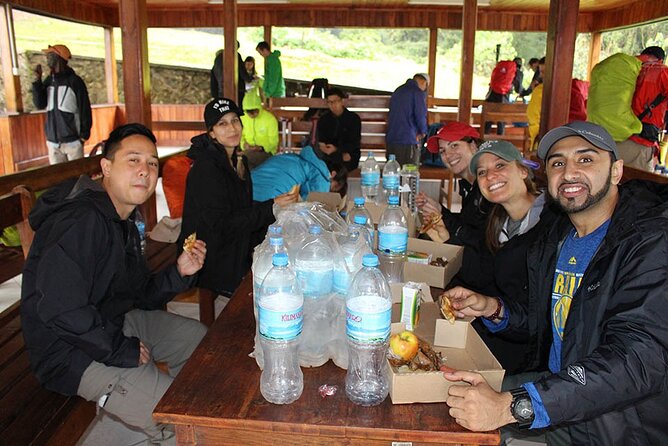
- Camping, meals, water, porters, park fees, and an English-speaking guide and cook are included in the $2,500 price.
- The support team matters, and guides such as Samuel, Justin, Edgar, and Abouh are praised for motivation, care, and attention.
Why the Machame Route earns its Whiskey nickname
Machame is often called the Whiskey Route, a playful contrast with Kilimanjaro’s easier Marangu Route, sometimes called the Coca-Cola Route. The nickname hints at the route’s character: tougher, more physical, and more rewarding for people who want a proper mountain trek.
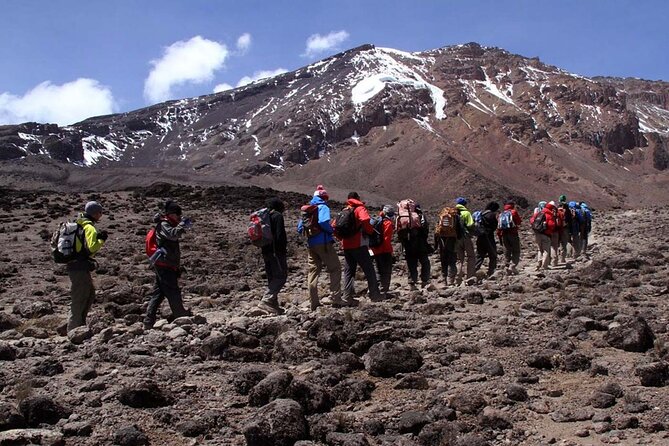
The scenery is the real reason to choose it. You move through several ecological zones in one week. The rainforest can be muddy and slippery, while the upper mountain becomes dry, rocky, exposed, and cold. You get glaciers, wide views across the Shira Plateau, volcanic rock, and the famous Barranco Wall.
The route is considered difficult because this seven-day version keeps the schedule tight. You are not walking far every day, but altitude changes the meaning of every kilometer. A moderate physical fitness level is listed as the minimum, though I would treat that as a floor rather than a target. Hiking or backpacking experience at altitude would make the trip easier to manage.
Other routes up the mountain from Arusha:
- 8-Day Small-group Lemosho Kilimanjaro Summit Trekking
★ 5.0 · 186 reviews - 5 Days Best of Tanzania Luxury Safari Northern Circuit
★ 5.0 · 174 reviews - 7-Day Machame Kilimanjaro Summit Tour from Arusha
★ 5.0 · 125 reviews
Day 1: Mud, rainforest, and Machame Camp
Your day begins with an early breakfast and pickup in Arusha at about 1,400 meters. The stated meeting point is Arusha Airport at 7:00 a.m., and pickup is offered. You drive to Machame Village, where you can buy mineral water and collect a packed lunch.
The final approach to the Machame Gate depends on road conditions. If vehicles cannot continue, you walk roughly 3 kilometers from the village. The route may be muddy, and this transfer walk can take about an hour before the official hike even begins.
After registration at the gate, you enter the rainforest almost at once. This is a beautiful start, but it is not a polished park stroll. Rain can turn the trail into a soggy, slippery mess, so good footwear and patience matter more than speed.
The total hiking day takes about eight hours. You stop for lunch around the midpoint, then continue uphill toward Machame Camp. The first day gives you a useful taste of the trek: wet ground, dense forest, steady climbing, and the need to keep your gear protected from rain.
Day 2: Shira Plateau and the first cold night
Day two covers about 9 kilometers in roughly six to seven hours. You leave the forest behind, climb toward the moorland zone, and then continue across the Shira Plateau.
The morning starts with a steeper climb for about an hour. The trail then eases for a couple of hours through moorland, followed by a short lunch and rest. A rocky ridge leads toward Shira Camp at about 3,840 meters.
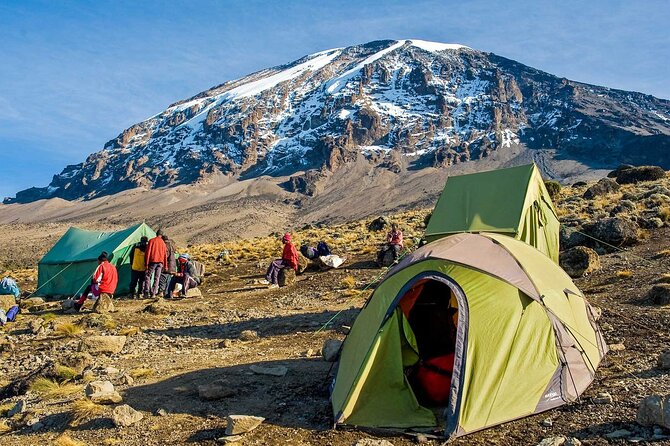
The setting changes quickly. The forest gives way to open ground, and you can look east toward the Western Breach and its glaciers. You are now west of Kibo, Kilimanjaro’s highest cone, with a much more exposed campsite than the previous night.
Your porters boil water for drinking and washing, and dinner is served at camp. Temperatures can drop well below freezing, so you need a warm sleeping setup and clothing that works after sunset. The included camping gear helps with the load, but mountain gear itself is not included. You must bring or rent that separately.
Day 3: Lava Tower makes altitude impossible to ignore
Day three is the route’s main acclimatization test. You walk into a semi-desert zone of rock and scree, reaching Lava Tower at approximately 4,630 meters after about five hours.
This is often the point where altitude symptoms become noticeable. Breathlessness, headaches, and irritability can appear even in fit people. The important feature is not simply reaching Lava Tower. After lunch, you descend by nearly 680 meters to Barranco Camp, allowing your body to sleep lower than the highest point reached that day.
That high-up, sleep-lower pattern is one of the best parts of this itinerary. It gives you a real chance to adjust before the summit push. Still, do not treat the descent as an easy finish. The route remains rocky, and the day can last about eight hours.
You should tell your guide promptly if you feel unwell. The named guiding team, including Samuel, Justin, and Edgar, is praised for staying attentive and reassuring hikers. That kind of steady human support is especially valuable on a day when the mountain begins to feel serious.
Same base, a different kind of day out:
- Serengeti Balloon Safari and authentic bush breakfast
★ 5.0 · 2,480 reviews - Balloon Safari & Bush Breakfast in Serengeti – Miracle Experience
★ 5.0 · 1,646 reviews - Tanzania Classic – 7 Days
★ 5.0 · 1,151 reviews - 4 Days Group Camping Safari
★ 5.0 · 1,101 reviews
Day 4: The Barranco Wall and the Karanga Valley
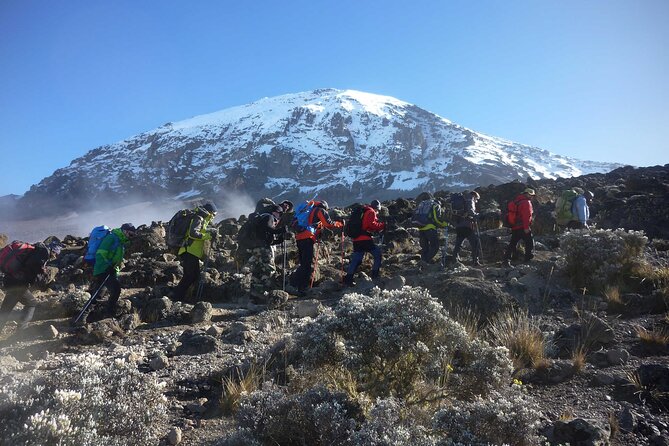
Day four is shorter, at about 4 to 5 hours and roughly 5 kilometers, but it has one of the trek’s most memorable features: the Great Barranco Wall.
From below, the wall can look intimidating. The route is rated Class 2, yet many hikers find it less difficult than expected once they begin. You will use your hands at points and need to pay attention to your footing, but this is not presented as a technical climbing pitch.
At the top, you can see Heim Glacier and look out above the clouds. That reward comes fairly early in the day, leaving time for the trail to wind through the Karanga Valley.
This is an important rest and acclimatization day. The short distance does not mean you can relax completely. You are still walking at high altitude, and the repeated ups and downs can feel tiring. The slower pace is useful because it lets you conserve energy for the summit night.
Day 5: Barafu Camp and a very exposed sleep
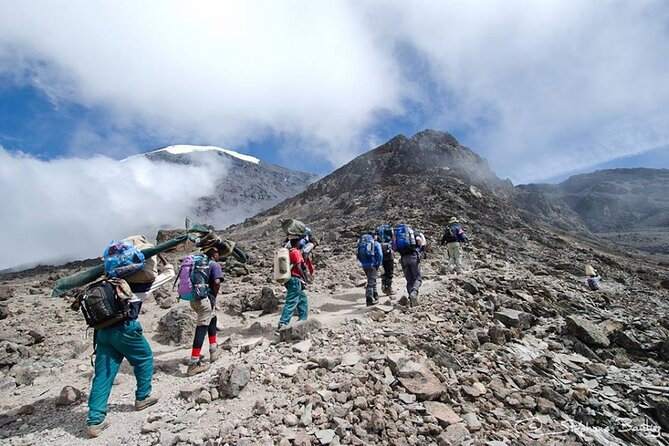
After breakfast, you leave Karanga Camp at about 3,959 meters and climb toward Barafu Hut at around 4,550 meters. The walk takes about two to three hours and covers approximately 4 kilometers.
The trail joins the Mweka Route, which you will use during the final descent. Barafu is the last water stop for the porters because there is no accessible water at camp. That detail explains why water planning and porter support matter so much here.
Barafu means ice in Swahili. The camp sits on a rocky, exposed ridge, with tents subject to wind and uneven ground. You should look around the campsite before dark so you know where you are going when you rise for the summit attempt.
Dinner is served early, followed by a short rest. The schedule is awkward by design. You are trying to sleep in the early evening, then get up around 11:30 p.m. for tea and biscuits. If you are a light sleeper, do not expect a normal night.
Day 6: Stella Point, sunrise, and Uhuru Peak
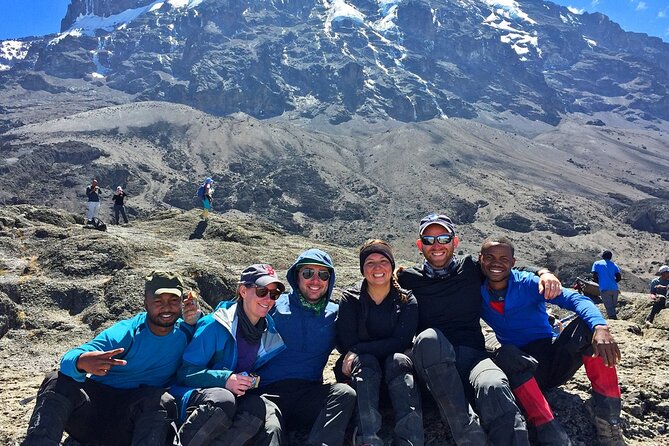
Summit day is the hardest part of the trek. You leave in darkness and climb northwest through heavy scree toward Stella Point at 5,685 meters. The walk to Stella Point can take about six hours, and the combination of altitude, cold, darkness, and loose rock makes it mentally demanding.
At Stella Point, you pause near the crater rim. If the weather cooperates, sunrise is the great payoff. From there, you normally encounter snow on the two-hour climb toward Uhuru Peak, the highest point on Kilimanjaro at 5,895 meters.
The time you spend at the summit depends on weather conditions. You should not linger if the cold, wind, or altitude is becoming unsafe. Reaching Stella Point still earns a green completion certificate, while reaching Uhuru Peak earns a gold certificate.
The descent is not an afterthought. You return to Barafu Camp and then continue toward the lower campsite, according to the mountain team’s schedule. After the strain of the ascent, loose scree on the way down can be hard on tired knees. This is the day when motivation and calm pacing count most.
Day 7: Forest descent, certificates, and the end of the trek
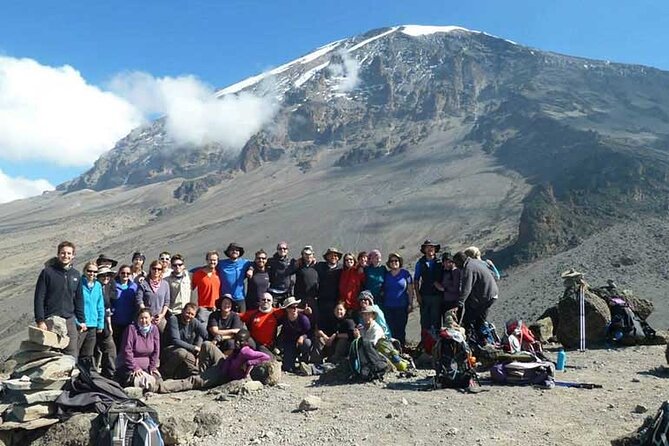
After breakfast, the mountain staff hold a celebration with dancing and singing. You also present tips to the guides, assistant guides, cook or cooks, and porters. Tips are not included in the $2,500 price, so plan for this additional cost.
The final descent takes about three hours through forest to Mweka Gate, covering roughly 15 kilometers. At the gate, you sign your name and receive your certificate. You then continue down to Mweka Village, a walk of about one hour and 3 kilometers.
This final day is longer than the short camp-to-camp distance might suggest. Your legs may be tired, and downhill walking can be surprisingly demanding after summit night. Still, reaching the gate gives the week a clear finish, with the certificate marking either Stella Point or Uhuru Peak.
What the $2,500 price covers
At $2,500 per person, the price is not a budget walk, but it covers the core costs of a guided Kilimanjaro expedition. Included items are:
- Park fees, all listed taxes, and other stated fees
- Camping equipment
- Porter support
- An English-speaking mountain guide
- A cook
- Bottled water, at least 3 liters per day
- Six lunches
- Six dinners
- Five breakfasts
The value comes from the infrastructure needed on Kilimanjaro. You are not carrying every shared item yourself, and the team handles meals, water preparation, camp equipment, and route support.
You still need to budget for flights, a visa, tips, and mountain gear. The last category can be significant because you need clothing and equipment suited to rain, freezing nights, wind, and high altitude. The supplied details do not specify which individual gear items are available for hire, so ask the operator before you arrive.
A maximum group size of 15 is listed. That is large enough to create a social camp atmosphere, but small enough for guides to keep track of the group. The quality of the experience will depend heavily on how well the guides manage different hiking speeds and altitude symptoms.
The guide team is a major part of the value
The strongest praise for this operation focuses on the people. Abouh is identified as head guide, while Samuel, Justin, and Edgar are named as guides who keep morale high and provide reassurance during the climb.
That matters on Kilimanjaro. Route knowledge is only one part of the job. You also want guides who pay attention when someone is tired, anxious, or struggling with altitude. The descriptions of this team emphasize kindness, support, safety, and good humor.
You should still ask practical questions before departure. Confirm how many guides will accompany your group, how water is distributed, what camping equipment is supplied, and how the team handles a hiker who cannot continue. The information provided gives a good picture of the support, but not every operating detail.
Who should book this trek?
I would choose this route if you want the most scenic of the standard Kilimanjaro options and are comfortable with a hard week. It suits hikers with moderate fitness and some background in hiking, backpacking, or high-altitude walking.
You should think twice if your main goal is a relaxed holiday. The first day can be wet and slippery, camps become cold and exposed, the Barranco section involves hands-on scrambling, and summit night interrupts your sleep. The seven-day schedule also leaves less room than a longer itinerary for a slow adjustment.
The route does offer one important advantage: its high point at Lava Tower followed by a lower camp at Barranco. That makes the schedule more sensible than a simple nonstop climb. Even so, no itinerary can remove the risks and discomfort of altitude.
Booking details worth knowing
Confirmation is provided at booking, and free cancellation is available if you cancel at least 24 hours before the experience start time. Cancellations inside that 24-hour period are not refunded, and changes are not accepted then.
The listed start time is 7:00 a.m., with Arusha Airport given as the meeting point. Pickup is offered, and the activity is near public transportation. The experience uses a mobile ticket.
Should you book the Machame Route?
Book this trek if you want Kilimanjaro’s rainforest, moorland, glaciers, volcanic rock, Barranco Wall, and summit sunrise in one demanding week. The $2,500 cost is reasonable for the stated park fees, porters, camping setup, meals, water, cook, and guide support, though mountain gear, tips, flights, and visa costs remain yours.
I would be especially comfortable choosing it for a fit hiker who values attentive guides and does not mind rough conditions. If you want the best odds of handling the altitude, arrive prepared, walk slowly, protect your water from freezing conditions, and treat every symptom seriously. If that sounds like the kind of challenge you want, the Machame Route gives you a strong, scenic path to Uhuru Peak.
FAQ
How long is the Machame Route experience?
The trek lasts approximately seven days. It includes six lunches, six dinners, and five breakfasts, with the final day ending after the descent through Mweka Gate and onward to Mweka Village.
Where does the trek start?
Pickup is offered from Arusha, and Arusha Airport is listed as the meeting point at 7:00 a.m. The first mountain transfer goes to Machame Village and then toward Machame Gate.
Is the Machame Route suitable for beginners?
The route requires a moderate physical fitness level and is described as steep, difficult, and challenging. It is better suited to people with hiking, backpacking, or high-altitude experience.
What is included in the $2,500 price?
The price includes meals and at least 3 liters of bottled water per day, fees and taxes, camping equipment, porter support, an English-speaking mountain guide, and a cook.
Are tips and mountain gear included?
No. Tips, flights, visa fees, and mountain gear are not included in the price.
How large can the group be?
The maximum group size is 15 people.
More Hiking & Trekking in Arusha
- 4 Days Mount Meru Trekking
★ 5.0 · 55 reviews - 6 Days Serengeti Safari(hiking waterfalls &coffee tour)
★ 5.0 · 48 reviews - Arusha: Napuru Waterfalls Guided Hike
★ 4.8 · 39 reviews - Mount Kilimanjaro Day Hike Through Marangu Route to Mandara Hut
★ 5.0 · 37 reviews
More Kilimanjaro treks from Arusha
- Mountain Kilimanjaro Day Hike
★ 5.0 · 102 reviews - Private Full Day Hiking Experience to Marangu Route
★ 5.0 · 61 reviews - From Arusha/Moshi: Kilimanjaro Hike Marangu Route Day Trip
★ 4.5 · 54 reviews - 4 days Best experience Kilimanjaro Hike, Serengeti &Ngorongoro
★ 5.0 · 54 reviews
Just added in Arusha
- Extraordinary Hot air Bolloon ride in Serengeti | BURIGI CHATO SAFARIS CO L.T.D★ 5.0 · 6 reviews
- 4 Days Private Midrange Lodge Safari to Serengeti & Ngorongoro★ 5.0 · 4 reviews
- 3 days leopard safaris★ 5.0 · 4 reviews
- 8 Days Serengeti Migration safari★ 5.0 · 11 reviews
- tarangire, ngorongoro & lake manyara park 3 days private tour★ 5.0 · 11 reviews
- Mt. Kilimanjaro: Shira plateau to Cathedral point 3872m Day hike★ 5.0 · 7 reviews
- serengeti, ngorongoro & tarangire 4 days private tour★ 5.0 · 18 reviews
- tarangire & ngorongoro 2 days tour★ 5.0 · 14 reviews
Kilimanjaro Treks, compared.



8-Day Small-group Lemosho Kilimanjaro Summit Trekking
Read our review →

5 Days Best of Tanzania Luxury Safari Northern Circuit
Read our review →

Climbing Kilimanjaro through 7 days Machame Route
Read our review →
7-Day Machame Kilimanjaro Summit Tour from Arusha
Read our review →Browse the lists this tour appears in